
TinyML: Teaching Microcontrollers to Think
Blog by Nihal Noushad K
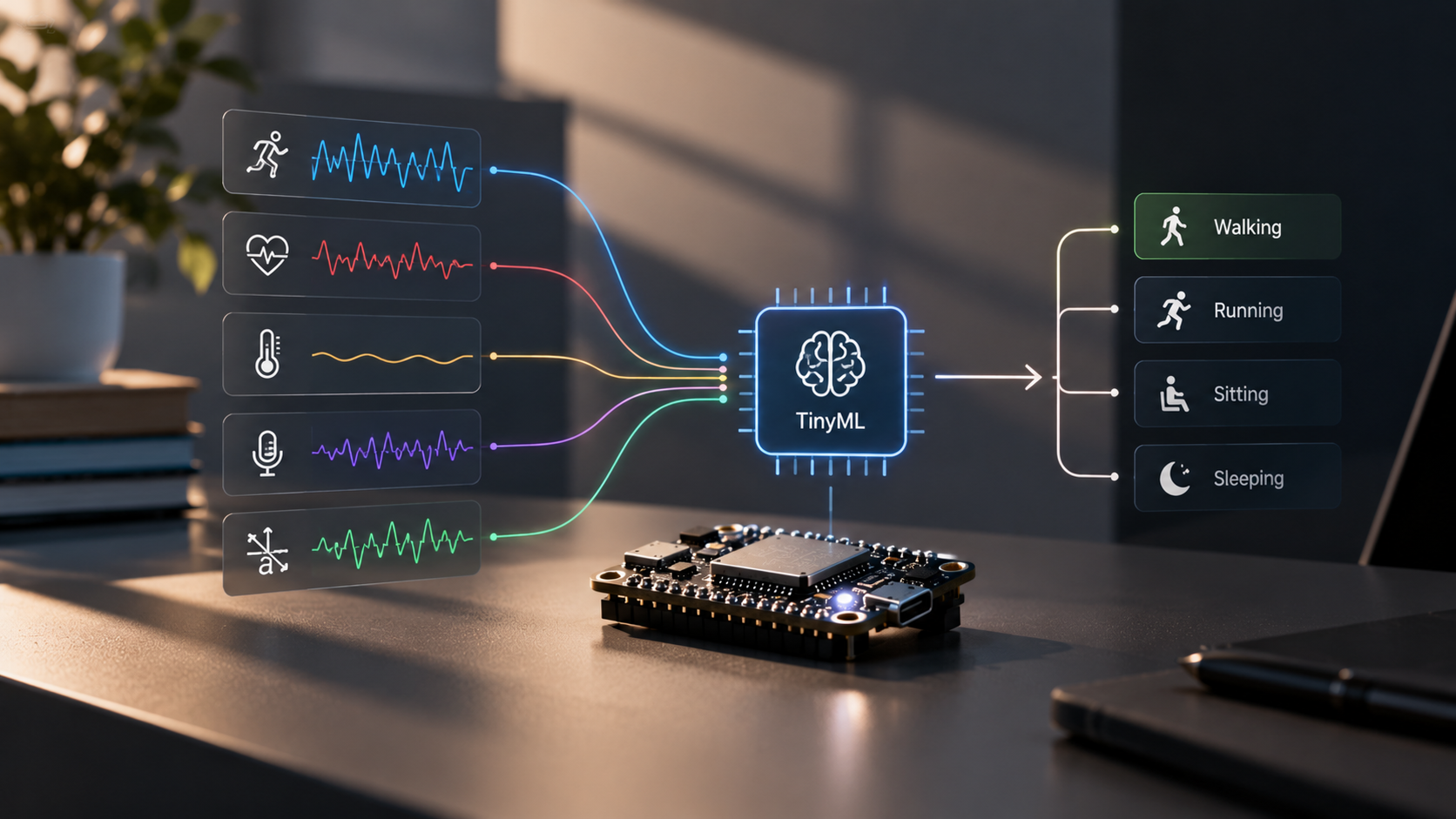
Have you ever wondered how smart wearable devices recognize your movements, or how industrial machinery can detect a failing part before it breaks down—all without sending continuous data to the cloud?
The answer lies in bringing machine learning closer to the physical world.
This is the domain of TinyML.
What Is TinyML?
TinyML refers to the development and deployment of machine-learning models on devices with extremely limited computing resources, particularly microcontrollers and other low-power embedded processors.
Traditional machine-learning systems rely on powerful cloud servers or GPUs. TinyML takes a different path: it uses compact models and efficient computation to perform specific inference tasks directly on small, inexpensive, battery-powered devices.
A typical TinyML system includes:
- Sensors: Capture physical information such as motion, temperature, sound, pressure, or light.
- Microcontroller: Reads sensor data and executes the embedded application.
- Machine-learning model: Identifies patterns and produces predictions or classifications.
- Output or control system: Uses the model’s results to trigger an alert, activate an actuator, or change device behavior.
Microcontrollers like the ARM Cortex-M family and boards like the Arduino Nano 33 BLE Sense can support suitable machine-learning applications, depending on processor performance, memory, and model complexity.
How Does TinyML Work?
A TinyML application connects conventional embedded-system engineering with machine learning through a specific workflow:
1. Collecting data from the physical world
The process begins with sensors (accelerometers, microphones, temperature sensors, etc.) gathering raw environmental measurements. Quality data is critical; poor sensor placement or electrical noise can reduce model accuracy.
2. Training the machine-learning model
The collected data is labeled and used to train a model on a computer. Developers may use small neural networks, decision trees, or other lightweight algorithms depending on accuracy, memory, and power requirements.
3. Optimizing the model for embedded hardware
Because standard models are often too large for microcontrollers, developers apply optimization techniques:
- Quantization: Represents weights using lower-precision formats (like 8-bit integers).
- Pruning: Removes less useful model connections or parameters.
- Architecture optimization: Uses smaller networks and simpler operations.
4. Deploying the model to a microcontroller
Using frameworks like TensorFlow Lite for Microcontrollers or Edge Impulse, the optimized model is converted, integrated into device firmware, and configured to handle sensor acquisition, preprocessing, and inference.
5. Making decisions locally
The device receives new sensor readings, executes inference, and combines the model’s output with firmware logic to trigger actions—such as updating activity states or issuing safety warnings.
Why Run AI on a Microcontroller?
Moving intelligence to the edge offers several key benefits:
- Lower latency: Processing data locally eliminates the need to send every measurement to a remote server and wait for a response.
- Improved privacy: Sensitive sensor data or audio can remain on the device rather than being continuously streamed to the cloud.
- Reduced connectivity dependence: Devices can perform trained tasks even when Wi-Fi or mobile connectivity is unavailable.
- Lower system-level power consumption: Reducing frequent wireless communication can significantly save energy.
- Lower hardware and operating costs: Inexpensive microcontrollers replace the need for powerful processors or recurring cloud infrastructure services.
Real-World Applications of TinyML
TinyML is transforming how industries utilize data in constrained environments:
- Smart wearables and health monitoring: Classifying activities, recognizing movement patterns, and tracking physiological signals locally.
- Predictive maintenance: Monitoring industrial equipment vibrations or acoustic signals to identify abnormal operating behavior early.
- Voice-controlled devices: Recognizing wake words or specific commands locally without continuous audio streaming.
- Smart agriculture: Analyzing soil-moisture or temperature sensor measurements to support smarter irrigation decisions.
- Robotics and interactive devices: Interpreting gestures and sensor events locally for immediate reactions.
The Engineering Challenges Behind TinyML
Despite its advantages, building TinyML systems introduces unique challenges:
- Memory constraints: Models must fit into limited RAM and flash storage alongside firmware and communication stacks.
- Processing limitations: Complex neural networks or high-frequency sensor streams can easily exceed computational budgets.
- Power management: Active processing time and sensor sampling must be carefully scheduled via sleep modes and event-driven processing.
- Data quality and reliability: Real-world variations in hardware or environmental conditions require robust testing and fallback behaviors.
A Gentle Reminder
“The real promise of TinyML is not making microcontrollers as powerful as computers. It is giving small devices just enough intelligence to do their jobs better.”
As embedded processors, optimization techniques, and development tools continue to evolve, TinyML will remain a cornerstone for creating responsive, privacy-conscious, and energy-efficient smart devices at the edge.
