
Beyond Chatbots: How Embodied AI Is Giving Machines a Physical Presence
Blog by Nihal Noushad K
Introduction: When AI Moves Beyond the Screen
For years, artificial intelligence has largely been experienced through screens, voice assistants, and chat interfaces. We type a question, receive an answer, and move on. But what happens when AI has a physical body, can observe its surroundings, recognise familiar people, and express itself through movement?
This is the idea behind embodied AI, artificial intelligence operating through a physical system that can perceive, interact with, and respond to its environment.
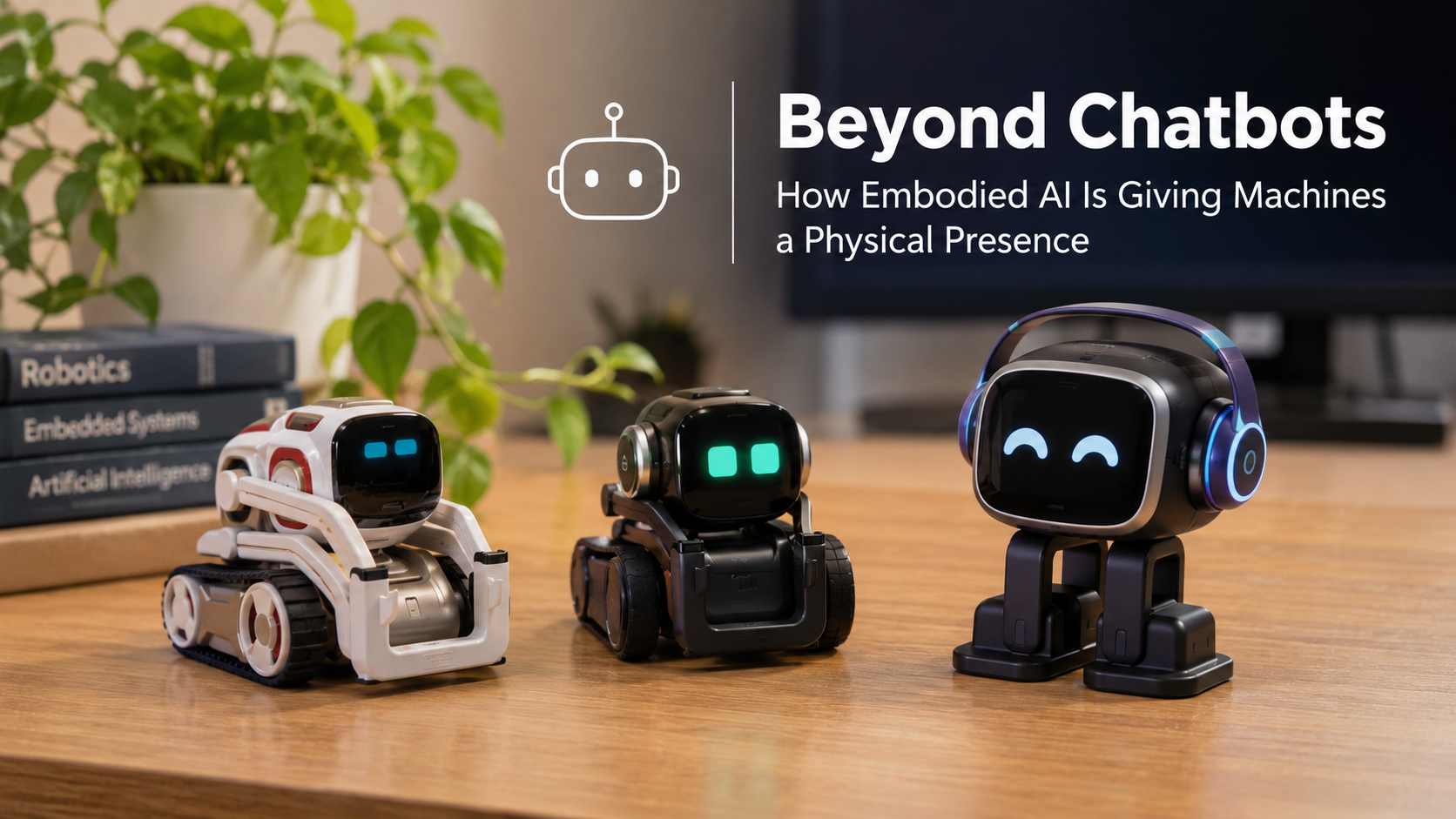
Small companion robots provide an interesting glimpse into this future. Anki’s Cozmo and Vector, along with LivingAI’s EMO, combine cameras, sensors, motors, and expressive behaviours to create devices that feel more interactive than conventional digital assistants.
These robots are not simply chatbots attached to moving bodies. Their appeal comes from the combination of perception, physical behaviour, environmental awareness, and personality-like responses.
However, many traditional companion robots rely on predefined animations, programmed behaviours, specialised recognition models, or limited conversational systems. Recent advances in large language models (LLMs), multimodal AI, and robotics offer new possibilities for making these interactions more flexible, contextual, and natural.
The next step in companion robotics may not be about making robots physically larger or more powerful. It may be about making small devices understand more, remember useful context, and respond more meaningfully to the people around them.
What Makes a Robot an Embodied AI System?
A conventional chatbot primarily receives digital input and generates a response. An embodied AI system must connect intelligence to a physical environment.
It needs to perceive what is happening, interpret the available information, choose an appropriate response, and execute that response through hardware.
A simplified embodied AI system consists of four interconnected elements:
- Perception: Cameras, microphones, touch sensors, and motion sensors collect information about the environment.
- Intelligence: AI models interpret observations, recognise patterns, understand instructions, and help select an appropriate response.
- Action: Motors, wheels, speakers, displays, and other actuators turn decisions into physical behaviour.
- Feedback: New sensor readings help the system determine what happened and what to do next.
For a companion robot, this feedback loop might be as simple as detecting a gentle tap on its head, interpreting it as an interaction, and responding with a playful animation or sound.
More advanced systems could combine visual information, speech, movement, and interaction history to generate responses suited to the situation.
The distinction is important: an AI model may generate an intelligent answer, but a robot must also execute that answer safely and consistently through its physical hardware.
Companion Robots That Paved the Way
Cozmo: Personality Through Play
Anki’s Cozmo demonstrated how a small robot could create an engaging personality through a combination of computer vision, expressive animations, movement, and interactive games.
Cozmo uses a camera to observe its surroundings and can recognise faces and interact with its environment through its software and development tools. Its animated screen, movements, sounds, and interactions with its light-up cubes help communicate a range of personality-like behaviours. The Cozmo SDK also allows developers to access camera events, control robot actions, and create custom interactions.
Much of Cozmo’s charm comes from how it behaves rather than from sophisticated conversation. It can appear curious, playful, or frustrated through carefully designed animations and reactions.
With a modern LLM integration, a robot with similar capabilities could potentially go beyond fixed dialogue or predefined interaction sequences. It might explain a game in natural language, invent new challenges, or respond to a conversation in ways that account for previous interactions.
However, this would require additional software integration. It should not be assumed that Cozmo’s original hardware and software already support modern LLM capabilities.
Vector: A Connected Robot With Environmental Awareness
Anki’s Vector took a related approach, combining a compact mobile platform with environmental sensing, expressive behaviour, and voice interaction.
Its small form factor illustrates an important principle in companion robotics: a device does not need human-like dimensions to create a sense of physical presence. Movement, orientation, sounds, and reactions can communicate intent and personality.
A modern AI system could potentially make this interaction more flexible. Instead of relying exclusively on predefined voice commands and responses, an upgraded architecture might allow a robot to answer open-ended questions, explain what it sees, or connect a spoken request to an appropriate supported action.
For example, if asked what is on a desk, a robot with suitable visual capabilities could identify visible objects and describe them conversationally.
The important distinction is between conversational understanding and physical capability. An LLM may understand a request, but the robot still needs the appropriate sensors, software interfaces, and movement capabilities to fulfil it.
EMO: Expressive Interaction in a Compact Form
LivingAI’s EMO is another example of a companion robot built around personality and environmental interaction.
According to the manufacturer, EMO incorporates an HD camera, a four-microphone array, a touch sensor, multiple other sensors, and a neural processing unit. It can recognise people and objects, respond to touch and sound, move around a desktop, and express itself through a large library of animations and movements.
These features provide a useful foundation for exploring more advanced companion AI.
An LLM-powered version of this type of robot could potentially generate more varied conversations, answer follow-up questions, and adapt its conversational style to a user’s preferences. Multimodal AI could also help connect what the robot sees and hears with what it says.
But expressive behaviour and genuine understanding are not the same thing. A robot displaying a happy animation does not establish that it experiences happiness. Similarly, recognising a familiar face does not necessarily mean it understands that person’s emotional state.
The engineering opportunity is to build more coherent and context-aware interactions without confusing simulated personality with human-like consciousness.
How Large Language Models Could Transform Companion Robots
Large language models have significantly expanded the possibilities for natural-language interaction. Rather than responding only to a limited set of commands, an LLM can interpret varied phrasing, maintain conversational context, explain information, and generate responses adapted to the situation.
When combined with a physical robot, these capabilities could change several aspects of the user experience.
1. From Scripted Responses to Natural Conversations
Traditional companion robots often depend on predefined dialogue, command recognition, and programmed response patterns.
An LLM could enable a more flexible conversational layer. Users could ask questions in their own words, follow up on earlier conversations, or discuss a topic without needing to memorise specific commands.
Imagine asking a small desktop robot, “Why do you keep looking at that object?” If the robot has suitable visual perception and access to its internal state, it could explain that the object has attracted its attention or that it is responding to a programmed exploration behaviour.
The response would need to be grounded in actual sensor data and robot state. Without that grounding, a language model could produce a plausible but incorrect explanation.
2. Contextual Memory and Personalisation
A companion becomes more useful when it can make appropriate use of previous interactions.
With a carefully designed memory system, a robot could remember a user’s preferred name, favourite games, recurring routines, or previously discussed interests. It could use this information to personalise conversations and activities.
For example, a robot might remember that a user enjoys space exploration and suggest a space-themed quiz during a later interaction.
This does not require the model to retain every conversation indefinitely. A practical design could store selected preferences and summaries, retrieve relevant information when needed, and allow users to inspect or delete stored memories.
Personalisation also introduces privacy concerns. Designers must decide what is stored, where it is stored, how long it is retained, and whether the user has meaningful control over it.
3. Multimodal Understanding: Connecting Vision, Sound, and Touch
Text-only conversation provides an incomplete picture of a physical environment. Companion robots already possess physical sensors, but those signals become much more useful when an AI system can interpret them together.
Multimodal AI can combine information from images, audio, and other inputs to form a more contextual understanding of a situation.
Consider a robot equipped with a camera and microphone. It could potentially identify an object in view, understand a spoken question about that object, and generate a relevant response.
Touch and motion data could add another dimension. A robot might distinguish between being picked up, gently tapped, or moved abruptly, then select an appropriate response based on the event and its interaction history.
Not every input must be processed by a large model. Dedicated sensor-processing algorithms can handle simple events efficiently, while multimodal models interpret more complex situations when necessary.
4. More Varied and Adaptive Physical Behaviour
Language models are only one part of the picture. Companion robots also need a way to translate an interpreted situation into a physical response.
An AI system could select from a library of validated behaviours, such as turning towards a sound, playing an animation, moving a small distance, or initiating a game.
Over time, a robot could potentially combine these behaviours in different sequences rather than relying entirely on fixed interaction scripts.
For example, after detecting a familiar person, it might turn towards them, play a greeting animation, and begin a conversation related to a previously expressed interest.
This kind of flexibility requires coordination between AI-generated decisions and deterministic robot-control software. The model should select an appropriate action, while the robot’s control system verifies that the action is supported and safe to execute.
From Language Models to Physical Intelligence
An important development in robotics is the emergence of models designed specifically to connect AI reasoning with physical actions.
In March 2025, Google DeepMind introduced Gemini Robotics and Gemini Robotics-ER. The former was designed as a vision-language-action model, while the latter focused on embodied reasoning and spatial understanding. In June 2025, Google DeepMind also introduced Gemini Robotics On-Device, designed to run locally on robotic hardware.
These developments illustrate a broader direction in AI research: moving beyond systems that merely describe the world towards systems that can interpret physical situations and help determine what actions to take.
For companion robots, this could eventually support more flexible interactions with objects and environments. A robot might interpret a request, identify a relevant object, plan a supported action, and evaluate whether the action succeeded.
However, general-purpose robotic models are not automatically suitable for every small companion robot. Their usefulness depends on hardware compatibility, model requirements, available training data, control interfaces, and the tasks the robot is physically capable of performing.
A desktop robot with limited mobility and a small embedded processor has very different constraints from a full-size research robot.
The goal is not necessarily to run the largest available model inside every device. It is to combine the right AI capabilities with the available hardware.
The Hardware Challenge: Intelligence on a Small Budget
Adding advanced AI to a compact companion robot is as much a hardware-engineering challenge as it is a software challenge.
Processing and Memory
LLMs and multimodal models can require substantial memory and computational resources. Many small robots use embedded processors designed for low power consumption, predictable operation, and relatively simple workloads.
Running a large model entirely on such hardware may be impractical.
One solution is a hybrid architecture in which lightweight models run locally while a more capable cloud model handles complex conversations or reasoning tasks.
Another option is to use a more capable embedded processor or a dedicated AI accelerator, provided the additional cost, memory, and power requirements are acceptable.
Battery Life and Thermal Constraints
Companion robots are often expected to remain active throughout the day, react quickly, and operate quietly in homes or offices.
Continuous camera processing, audio analysis, wireless communication, and AI inference can increase power consumption.
Engineers must therefore balance responsiveness against battery life. The robot might use low-power sensing and event detection continuously, activating more demanding AI processing only when an interaction requires it.
Thermal design matters too. A compact enclosure has limited room to dissipate heat, particularly when a processor operates under sustained load.
Latency and Connectivity
Cloud-based models can provide greater computational capability, but they depend on network availability and introduce communication delays.
For a conversational response, a short delay may be acceptable. For a movement or safety-critical control loop, relying on a remote model would be inappropriate.
A well-designed architecture separates high-level reasoning from low-level control. The AI system may decide that the robot should turn towards a user, but local control software should handle motor timing, movement limits, obstacle avoidance, and emergency stops.
This separation allows a robot to remain responsive and safe even when the cloud connection is slow or unavailable.
A Practical Architecture for the Next Generation of Companion Robots
A promising design would combine local intelligence, cloud-based capabilities, and a reliable embedded control system.
The architecture could work as follows:
- Sensors collect information: Cameras, microphones, touch sensors, and inertial measurement units provide information about the user and the environment.
- Local processing identifies events: Lightweight algorithms detect wake words, touch interactions, movement, or other relevant changes.
- AI interprets the interaction: A local or cloud-based language or multimodal model interprets the user’s request using relevant context.
- A behaviour manager selects an action: The system maps the model’s output to a supported robot behaviour, such as speaking, turning, displaying an animation, or starting a game.
- The embedded controller executes the action: Motor controllers and other low-level components carry out the requested behaviour within predefined safety limits.
- Feedback updates the robot’s state: New sensor readings help determine whether the interaction succeeded and what should happen next.
This approach avoids treating an LLM as a replacement for the entire robot software stack. Instead, the language model acts as one component within a larger system, working alongside perception software, memory, behaviour management, and embedded control.
Privacy, Safety, and the Limits of Simulated Companionship
Companion robots may collect highly personal information through microphones, cameras, interaction histories, and behavioural observations.
If these devices become more conversational and context-aware, responsible data handling becomes even more important.
Engineers should consider local processing where practical, clear indicators for active sensing, secure communications, configurable data retention, and meaningful controls for disabling microphones or cameras.
Physical safety is equally important. A language model can misunderstand a request or generate an action that is inappropriate for the device. Its outputs should therefore be constrained by a separate action-validation layer, with movement limits and other safety mechanisms enforced independently.
There is also a human-factors consideration. More natural conversation can make a robot appear more understanding or emotionally aware than it actually is. Designers should avoid presenting generated responses as proof that a device has feelings, consciousness, or a clinical understanding of the user’s mental state.
A companion robot can still provide entertainment, interaction, reminders, and a sense of routine without making unsupported claims about emotional or medical capabilities.
Conclusion: The Future of Companion Robotics
Cozmo, Vector, and EMO demonstrate how cameras, sensors, movement, and expressive behaviour can make small robots engaging physical companions.
Advances in large language models, multimodal perception, and embodied reasoning create opportunities to expand these experiences beyond predefined commands and scripted interactions.
Future companion robots could offer more flexible conversations, better contextual awareness, personalised activities, and more adaptive physical responses.
Realising these capabilities will require more than connecting a robot to an LLM. It will require careful integration of AI models, sensors, embedded processors, memory, power management, and reliable control software.
For hardware engineers, this is where the opportunity lies: developing compact, efficient systems that combine the conversational flexibility of modern AI with the responsiveness and physical presence of a real device.
The next generation of companion robots may not need to look dramatically different from today’s devices. The more significant change could be in how well they interpret their surroundings, understand the context of an interaction, and respond in ways that feel useful and natural.
The future of companion robotics is not simply about giving AI a voice. It is about giving intelligence a way to perceive, interact with, and respond to the physical world.
