
AI Agents in 2026: How Autonomous Assistants Are Reshaping Work, Productivity, and Human Judgment
Blog by Varsha Vikraman
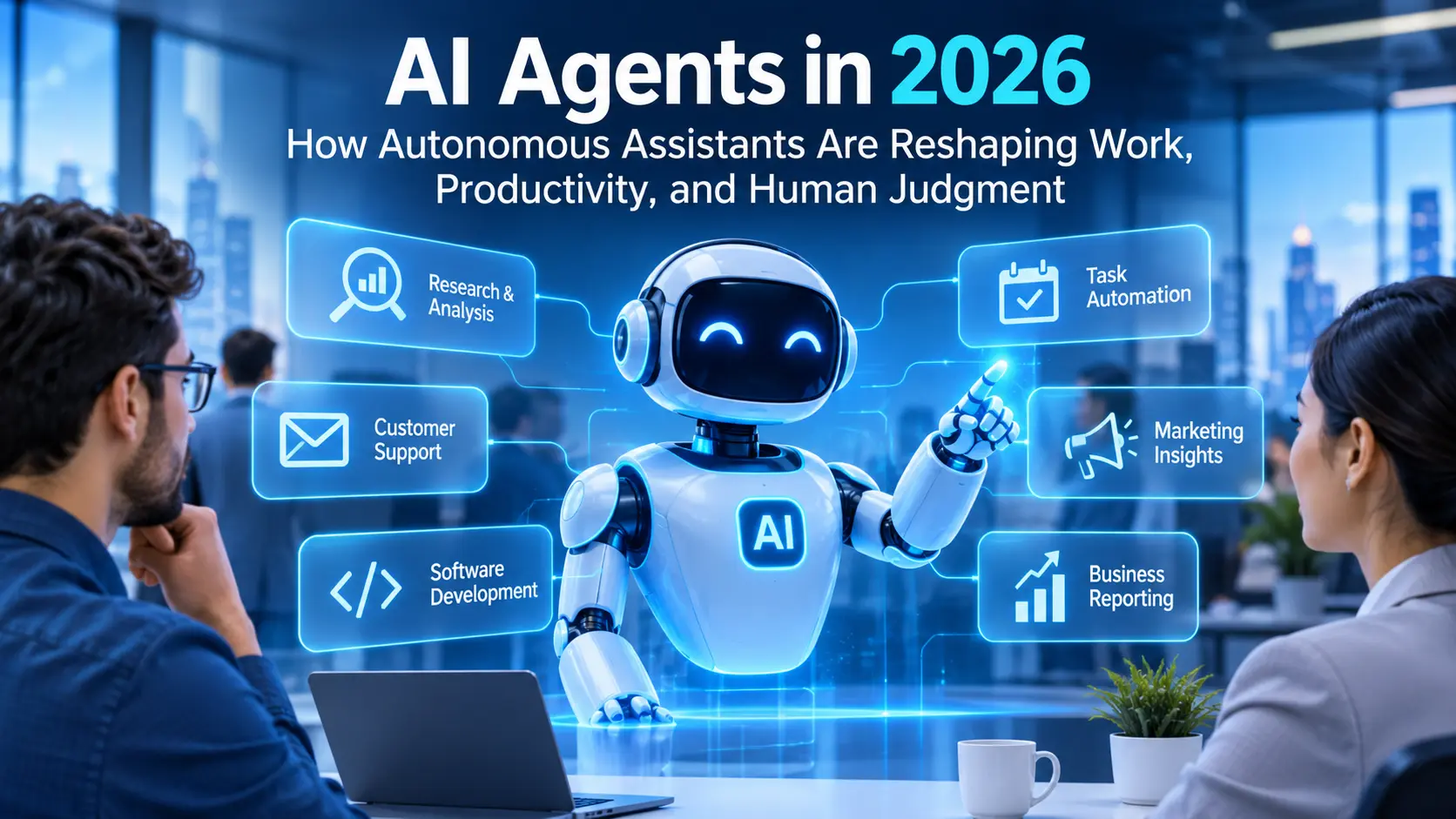
Artificial intelligence has moved beyond chatbots that answer questions and tools that generate content. In 2026, businesses are increasingly adopting AI agents: autonomous assistants that can understand a goal, plan a series of actions, use connected tools, and complete tasks with limited human supervision.
This shift is changing the way organizations operate. AI agents can reduce repetitive work, speed up decision-making, and help employees focus on higher-value activities. But greater autonomy also brings new risks around accuracy, security, privacy, accountability, and human oversight.
So, what exactly are AI agents, how do they work, and what does their growing adoption mean for the future of work?
Let’s explore.
What Are AI Agents?
An AI agent is an artificial intelligence system designed to pursue a goal rather than simply respond to a single prompt. Unlike a traditional chatbot, an AI agent can take an instruction such as “prepare a competitor analysis” or “resolve this customer issue” and carry out multiple steps to complete it.
A typical AI agent may be able to:
- Understand a user’s objective
- Break a complex task into smaller steps
- Search or retrieve information from approved sources
- Use tools such as calendars, CRMs, spreadsheets, email, and internal systems
- Create drafts, reports, recommendations, or actions
- Review results and adjust its approach
- Ask for human approval when needed
For example, instead of asking an AI chatbot to “write a follow-up email,” a sales team could ask an AI agent to review a prospect’s recent interactions, identify the best next step, draft a personalized email, update the CRM, and schedule a reminder.
The main difference is agency: the ability to act across a workflow, not merely generate a response.
AI Agents vs. Chatbots: What’s the Difference?
| Feature | Chatbots | AI Agents |
|---|---|---|
| Primary Purpose | Answering questions and generating text | Executing complete multi-step tasks and end-to-end workflows |
| Interaction Style | One prompt, one response conversational flow | Works toward broader goals using multi-step planning and self-correction |
| Tool Use | Minimal to no integration with external tools | Connects to and takes actions across approved software like CRMs, calendars, and spreadsheets |
| Autonomy | Low | Moderate to high, based on the permissions granted |
| Human Involvement | User prompting required at every step | Operates independently and checks in with humans for critical approvals |
| Best Use Cases | Quick research, drafting content, and brainstorming | Operational execution, cross-system coordination, and complex data analysis |
AI chatbots remain valuable for quick answers, writing support, and brainstorming. AI agents become more useful when a task involves several connected steps, multiple systems, or recurring workflows.
How AI Agents Are Reshaping the Workplace
AI agents are not simply replacing jobs. In many organizations, they are changing the nature of work by taking over repetitive coordination tasks and giving employees more time for judgment, creativity, and strategic thinking.
1. Reducing repetitive administrative work
Much of modern knowledge work involves searching for information, copying data between systems, following up on tasks, preparing reports, and coordinating with colleagues. AI agents can automate many of these steps.
For example, an operations agent could monitor incoming requests, categorize them, assign them to the right team, and create a daily summary for managers. This reduces manual effort while improving response times.
2. Improving decision-making with faster insights
AI agents can collect information from multiple sources, identify patterns, and prepare an initial analysis. This can help teams make faster, better-informed decisions.
A finance team, for example, could use an agent to monitor spending data, identify unusual transactions, compare performance against forecasts, and prepare a summary for review. The final decision still belongs to a person, but the agent reduces the time spent gathering and organizing data.
3. Supporting customer experience
Customer service is one of the most practical areas for AI agents. An agent can understand a customer request, retrieve relevant account information, suggest a resolution, draft a response, and escalate complex cases to a human representative.
The goal is not to remove humans from customer support. Instead, AI agents can handle routine requests while human agents focus on sensitive, complex, or emotionally important conversations.
4. Accelerating software development
Development teams can use AI agents to support the software lifecycle. Agents may help translate requirements into technical plans, generate initial code, review changes, run tests, identify bugs, and create documentation.
However, developers should treat AI-generated code as a draft, not a final product. Human review remains essential for security, performance, maintainability, and business logic.
5. Enabling more personalized marketing
Marketing teams can use AI agents to research audiences, analyze campaign performance, personalize messaging, and recommend next steps. An agent might identify which customer segments responded best to a campaign, suggest improvements, and prepare a report for the marketing team.
This can make marketing more data-driven, but brand voice, creative direction, and ethical messaging still require human oversight.
Key Benefits of AI Agents for Businesses
- Increased productivity: AI agents can complete repetitive tasks faster than manual processes. By automating coordination, data gathering, drafting, and follow-ups, they help employees spend more time on meaningful work.
- Better consistency: When configured with clear rules, AI agents can apply the same process consistently. This is especially useful for tasks such as ticket classification, document summarization, data validation, and report preparation.
- Faster response times: Agents can work continuously and respond quickly to triggers. For example, an agent can flag an urgent customer issue, notify the right team, and prepare relevant context before a human representative joins the conversation.
- Reduced operational costs: Automation can lower the cost of repetitive work. However, businesses should measure the full picture, including implementation costs, monitoring, security, and the time required to review AI outputs.
- Improved employee experience: By removing low-value administrative work, AI agents can help employees focus on problem-solving, customer relationships, innovation, and strategic planning.
Where AI Agents Create the Most Value
AI agents deliver the strongest results when tasks are:
- Repetitive and rule-based
- Data-rich
- Time-sensitive
- Easy to review
- Connected to multiple tools or systems
- Important but not high-risk without human approval
Strong use cases by department
- Customer Support: Automates ticket triage, drafts initial responses, searches internal knowledge bases, and escalates complex issues to human representatives.
- Sales: Conducts prospect research, updates CRM records, sets follow-up reminders, and prepares briefing notes for upcoming meetings.
- Marketing: Analyzes campaign performance data, drafts content briefs, extracts audience insights, and compiles regular reporting summaries.
- Finance: Supports invoice processing workflows, flags spending anomalies, generates financial summaries, and assists with account reconciliation.
- Human Resources: Assists with candidate screening, automates interview scheduling, and provides instant answers to common policy inquiries.
- IT: Categorizes incoming tickets, updates technical documentation, creates incident summaries, and runs routine system diagnostics.
- Operations: Coordinates cross-departmental workflows, assigns tasks, tracks project status, and monitors operational processes.
The Human Element: Why Judgment Still Matters
AI agents can process information quickly, but they do not truly understand context in the way people do. They may miss organizational politics, cultural nuances, ethical concerns, or the emotional impact of a decision.
Human judgment is especially important in areas involving:
- Hiring and performance evaluation
- Medical or legal advice
- Financial decisions
- Customer complaints
- Public communications
- Data privacy
- Safety-critical operations
- Strategic business decisions
A practical principle is: use AI to support decisions, not to remove responsibility from decision-makers.
For example, an AI agent may recommend that a customer receive a refund based on policy rules. But if the case involves a vulnerable customer, a reputational risk, or an unusual circumstance, a human should review the recommendation before action is taken.
Major Risks of Autonomous AI Assistants
Accuracy and hallucinations
AI systems can generate incorrect or misleading information with confidence. This is particularly risky when agents use AI outputs to make decisions or take actions. Businesses should require source verification, confidence thresholds, and human review for important outputs.
Data privacy and security
AI agents may need access to emails, calendars, customer records, internal documents, and business systems. Without strong access controls, this can create privacy and security risks. Organizations should use role-based permissions, encryption, audit logs, data-retention policies, and regular security reviews.
Bias and unfair outcomes
If an AI agent is trained or configured using biased data or flawed rules, it can produce unfair outcomes. This is a major concern in hiring, lending, insurance, education, and customer service. Regular testing, diverse review teams, and transparent decision criteria can help reduce this risk.
Lack of transparency
If an agent takes action without explaining why, teams may struggle to trust or correct its decisions. Businesses should prioritize systems that provide clear reasoning, source references, action logs, and audit trails.
Overreliance and skill erosion
If employees rely too heavily on AI, they may lose opportunities to develop critical thinking, communication, and problem-solving skills. AI should be positioned as a support system, not a replacement for professional expertise.
How to Implement AI Agents Responsibly
Successful AI adoption requires more than purchasing a tool. It requires clear goals, strong governance, and a culture of responsible use.
1. Start with a specific business problem
Do not adopt AI agents simply because the technology is trending. Identify a real bottleneck, such as slow customer response times, manual reporting, or repetitive data entry.
A good starting question is: Which recurring task consumes significant employee time but follows a predictable process?
2. Choose low-risk workflows first
Begin with tasks that are internal, reversible, and easy to review. Examples include meeting summaries, research briefs, first-draft reports, internal knowledge searches, and task coordination. Once accuracy and trust improve, expand to more complex workflows.
3. Define clear permissions
Give AI agents only the access they need. For example, an agent preparing a sales report may need access to CRM data, but it should not automatically send emails or make financial transactions. Apply the principle of least privilege: minimum access, maximum control.
4. Keep humans in the loop
Establish approval steps for high-impact actions. These may include:
- Sending customer communications
- Making payments or refunds
- Changing customer records
- Hiring decisions
- Legal or compliance-related actions
- Publishing public content
- Accessing sensitive data
5. Create evaluation metrics
Measure whether AI agents are actually improving outcomes. Useful metrics include:
- Time saved per task
- Error or exception rate
- Customer satisfaction
- First-response time
- Employee adoption rate
- Cost per completed workflow
- Number of escalations to humans
- Quality of AI-generated outputs
6. Train employees
Employees need to understand both the capabilities and limitations of AI agents. Training should cover prompt quality, data privacy, reviewing outputs, identifying errors, and knowing when to escalate.
The Future of AI Agents at Work
AI agents are likely to become more specialized and more deeply integrated into business software. Instead of using one general-purpose assistant, organizations may deploy multiple agents with defined roles.
For example, a business could use:
- A research agent to gather market and competitor insights
- An analysis agent to interpret performance data
- A communication agent to prepare updates and drafts
- An operations agent to coordinate tasks and follow-ups
- A governance agent to monitor permissions, compliance, and exceptions
The future will not be about replacing people with AI. It will be about designing smarter systems where AI handles execution and humans provide direction, accountability, and ethical oversight.
Final Thoughts
AI agents are reshaping work by turning artificial intelligence from a reactive tool into an active digital assistant. They can streamline workflows, improve productivity, and help teams make faster decisions.
However, the real value of AI agents comes from thoughtful implementation. Businesses that combine automation with human judgment, strong governance, and clear accountability will be best positioned to benefit from this shift.
“The goal is not to let AI make every decision. It is to let AI handle the work that slows people down, so people can focus on the decisions that matter most.”
