
Beyond the Hype: 5 Mind-Bending Realities of the AI Revolution in Human Medicine
Blog by Varsha Vikraman
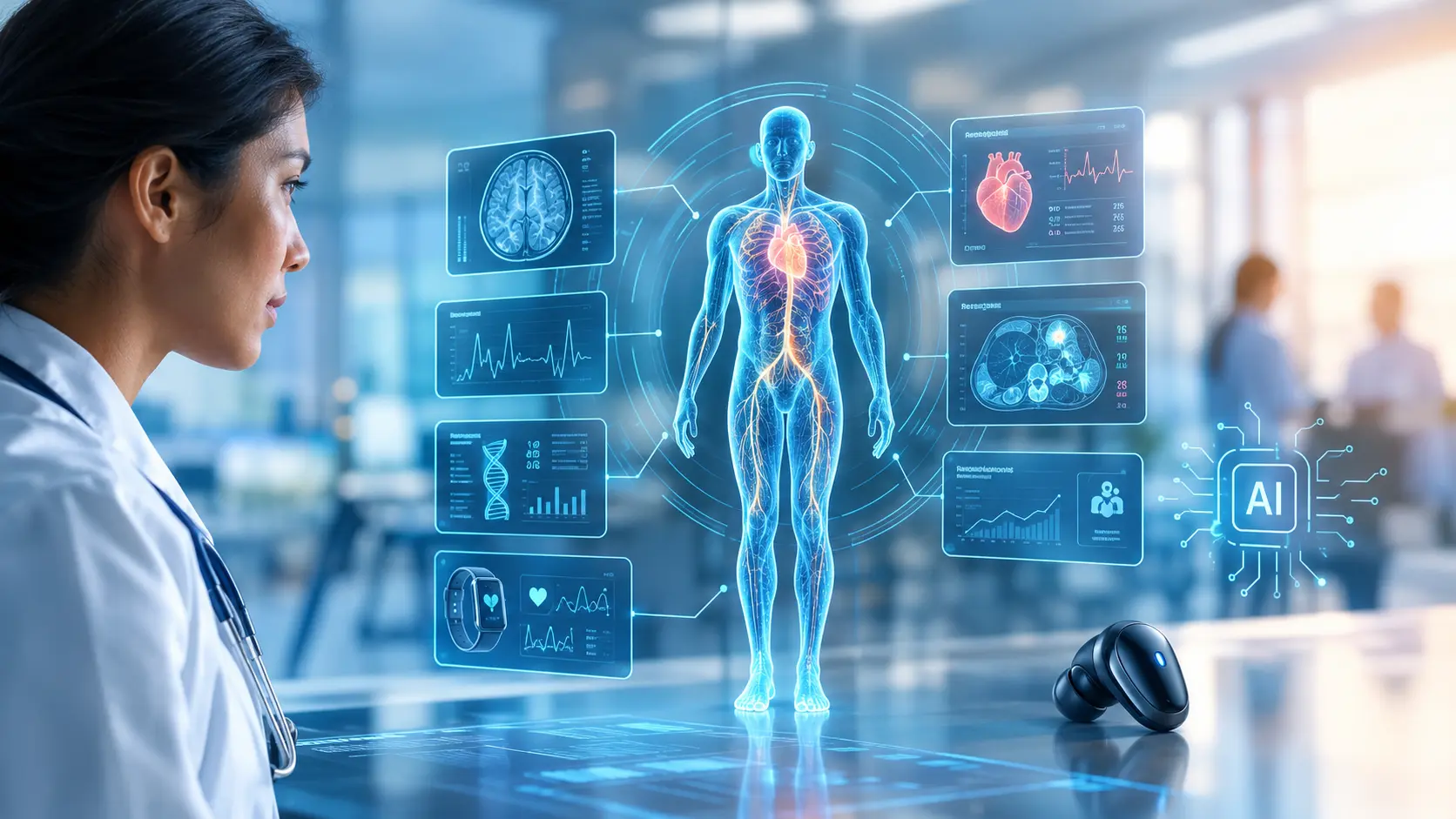
From virtual replicas of the human body to AI-powered diagnostics, the future of medicine is becoming increasingly computational. But as artificial intelligence transforms how we predict, prevent, and treat disease, a critical question remains: how do we advance healthcare technology without losing the human connection at its heart?
Introduction: When the Human Body Becomes Computational
Artificial intelligence has already transformed how we interact with information. It can generate code, analyse documents, create digital content, and help solve complex problems. Yet some of its most consequential applications are emerging far beyond the digital world—in the human body itself.
Healthcare is entering a new era in which artificial intelligence is moving beyond analysing isolated medical records and imaging results toward modelling complex biological systems over time. By combining medical imaging, electronic health records, genomic information, wearable sensors, and advanced machine learning, researchers are working toward computational representations of individual patients that could help predict disease progression and evaluate potential treatments.
At the centre of this transformation is the concept of the Human Body Digital Twin: a virtual representation of a person’s physiological state that can be updated with relevant health data and used to investigate possible future outcomes.
Imagine a clinical environment in which doctors can explore how a patient’s condition might evolve, compare potential treatment strategies in a computational model, and identify emerging risks before they become critical. Imagine clinical research in which virtual patient models help researchers evaluate experimental therapies before exposing real patients to unnecessary risks.
These possibilities are becoming important areas of research at the intersection of artificial intelligence, biomedical engineering, and precision medicine.
However, the implications extend beyond technological progress. They raise fundamental questions about patient privacy, clinical accountability, human judgement, and the meaning of compassionate care.
Five emerging developments illustrate why the AI revolution in medicine is about much more than automation.
1. Your Body Is Getting a Digital Avatar: Exploring the Research Framework
From Static Medical Records to Dynamic Health Models
Traditional healthcare often relies on snapshots of a patient’s condition: a blood test, an MRI scan, a blood pressure reading, or a consultation conducted at a particular moment. Although these measurements provide essential clinical information, they cannot always capture how the human body changes over time or how different biological systems interact.
Digital twins offer a different approach. Rather than treating every medical measurement as an isolated observation, a healthcare digital twin aims to integrate multiple sources of information into a computational model that can evolve as new data becomes available.
To structure ongoing academic investigation, researchers have proposed a comprehensive five-level conceptual research framework for human body digital twins (Tang et al., 2024). This framework serves as a theoretical roadmap for multidisciplinary development rather than an established clinical reality today.
Level 1: Cross-Sectional Models — Understanding the Present
The first level establishes a digital representation of a patient’s current physiological state. Medical imaging, laboratory results, wearable sensors, and other biometric measurements can contribute to this representation. Machine learning techniques can help identify relationships between these different data sources.
For example, computational models of the heart can simulate aspects of cardiac function, while advanced cellular mapping techniques can help researchers investigate the organisation of biological structures. Multimodal learning can connect information from different sources, allowing models to identify patterns that may not be apparent when each data stream is examined independently. The goal is to build a more integrated picture of the patient’s current health.
Level 2: Deductive Models — Predicting What Comes Next
Once a model can represent the present, the next challenge is predicting the future. Time-series architectures, including Recurrent Neural Networks (RNNs), Long Short-Term Memory (LSTM) networks, and Transformers, can analyse longitudinal health data to identify patterns associated with changing physiological conditions.
These models could help estimate disease progression, identify patients at elevated risk, or forecast changes in health indicators. For instance, a predictive system might analyse historical clinical measurements to estimate how a chronic condition could progress under different circumstances. However, predictions are not guarantees. Their reliability depends on data quality, model validation, the population being studied, and the complexity of the condition being modelled.
Level 3: Editable Models — Exploring Alternative Treatments
This level introduces one of the most compelling possibilities of digital twins: virtual experimentation. Instead of merely predicting what might happen, an editable model aims to estimate how a system could respond to a proposed intervention.
Researchers could investigate different medication strategies, examine possible surgical outcomes, or explore treatment scenarios in a computational environment. Transfer learning and parameter-efficient adaptation may help researchers customise existing models when data from specific interventions is limited. For clinicians, the long-term vision is a tool that supports comparisons between treatment options before decisions are made.
Such simulations would still require rigorous clinical validation. A predicted response in a digital model cannot automatically be treated as evidence that the same response will occur in a real patient.
Level 4: Evolutionary Models — Understanding the Impact of a Lifetime
Human health is shaped by more than genetics and medical treatment. Diet, air quality, physical activity, environmental exposures, social circumstances, and long-term lifestyle patterns can influence the development of disease. Evolutionary digital twin models aim to incorporate these factors into a changing representation of health.
By integrating relevant longitudinal information, researchers could investigate how accumulated exposures contribute to disease risk and how changes in a person’s circumstances might influence future outcomes. This moves the concept of personalised medicine beyond the immediate clinical encounter toward a more comprehensive understanding of health over time.
Level 5: Explainable Models — Understanding Why AI Makes a Prediction
A prediction is not always useful simply because it is accurate. In healthcare, clinicians need to understand the evidence behind an AI-generated recommendation, its limitations, and the circumstances in which it may fail.
Explainable AI techniques—including SHAP, LIME, and Grad-CAM—can help reveal which features or regions of an input influenced a model’s output. Causal inference methods can provide additional tools for investigating relationships between variables, although they do not automatically establish causation. The objective is to make AI systems easier to evaluate, question, and validate.
A digital twin that predicts a patient’s deterioration may be valuable. A system that also helps clinicians understand the contributing factors could be more useful for investigating potential interventions. Nevertheless, an explanation generated by an AI system is not necessarily a complete or correct account of the underlying biological mechanism.
The Role of Self-Supervised Learning
Building comprehensive digital twins requires large amounts of diverse health data, much of which may not have explicit labels. Self-supervised learning offers a way to learn useful representations from unlabelled data by training models to identify structure and relationships within the data itself.
Foundation models trained on physiological signals could potentially be adapted to specialised tasks using smaller, carefully labelled datasets. This approach may help researchers make better use of information collected through wearable devices, medical monitoring systems, and other sources.
The bigger picture: Human Body Digital Twins remain an evolving research area (Tang et al., 2024). They aim to connect current measurements, future predictions, treatment simulations, environmental influences, and interpretable AI into a more integrated approach to personalised medicine. The ongoing challenge is ensuring that these virtual representations remain sufficiently accurate, transparent, and clinically useful for the decisions they are intended to support.
2. Beyond the Wrist: Exploring Physiological Hearables
The Rise of In-Ear Form Factors
Wearable technology has made continuous health monitoring increasingly familiar. Smartwatches can track activity, estimate heart rate, and collect other physiological measurements. But the wrist is not the only place where useful health signals can be captured.
Researchers and hardware developers are actively investigating hearables: in-ear devices designed to capture physiological measurements while functioning as conventional audio units. The ear offers a promising anatomical site for health monitoring because in-ear placement can offer stable sensor contact in certain custom designs, maintaining close proximity to major superficial blood vessels. However, secure long-term fit, individual anatomical variance, and motion artefacts remain significant engineering challenges.
Rather than relying on a single measurement, advanced hearable architectures aim to integrate multiple sensing modalities into a compact device.
Current Sensing Modalities and Engineering Realities
One prominent optical technology thoroughly evaluated in literature is photoplethysmography (PPG), which tracks blood volume pulsations beneath the skin of the ear canal (Ferlini et al., 2022). While wrist-worn PPG is ubiquitous, implementing it inside the ear introduces unique design considerations, including secure fit, ambient light interference, and individual anatomical variance.
Beyond optical blood volume sensing, other physiological modalities are actively being explored as research possibilities rather than established consumer capabilities:
- Photoplethysmography (PPG): Optical measurement of blood volume and pulse characteristics (Ferlini et al., 2022).
- Electroencephalography (EEG): Detection of electrical signals from cerebral activity via specialized ear-canal electrodes.
- Electrocardiography (ECG): Measurement of cardiac electrical activity across trans-ear contact points.
- Microelectromechanical systems (MEMS) microphones: Capture of internal acoustic signals, such as swallowing or respiratory sounds.
- Accelerometers & IMUs: Measurement of head movement and physical activity.
Most commercial hearables available today remain restricted primarily to audio playback, active noise cancellation, and basic step or heart-rate tracking. Multi-modal physiological sensing inside the ear remains largely in the advanced research and prototyping phase.
Tackling Motion Artefacts
A primary hurdle in continuous physiological monitoring is motion artefact—unwanted noise introduced by body movement, talking, or chewing. Hearable prototypes combat this by pairing optical sensors with internal inertial measurement units (IMUs) and adaptive digital signal processing (DSP) filters (Ferlini et al., 2022).
By cross-referencing accelerometer data with optical streams, algorithms can isolate and subtract movement-induced distortion, improving data reliability during active daily routines.
What Could This Mean for Preventive Healthcare?
If engineering challenges are successfully addressed, comfortable in-ear sensors could eventually complement existing consumer wearables. By capturing continuous longitudinal telemetry during everyday wear, such devices could provide clinicians with richer baseline trends between scheduled appointments.
However, continuous tracking also increases the risk of false alarms and data fatigue. Systems must balance data density with clinical relevance to remain genuinely useful.
3. The Empathy Paradox: What Evaluations of AI Communication Actually Measure
When Communication and Emotional Understanding Diverge
Artificial intelligence is increasingly being explored for patient communication, clinical documentation, and healthcare information services. Large Language Models (LLMs) can draft messages, summarise medical information, and adapt explanations to different audiences.
In controlled studies evaluating patient-provider messaging—such as comparative evaluations of responses to medical questions posted on public online forums like Reddit’s AskDocs—human evaluators and licensed healthcare professionals frequently rated AI-generated responses as significantly higher in overall quality and perceived empathy than answers written by human clinicians (Ayers et al., 2023).
At first glance, this seems like a straightforward win for technology. Patients often navigate healthcare during stressful or vulnerable moments. A clear, patient, and reassuring explanation can make a meaningful difference to their experience. If AI can assist healthcare professionals in drafting clearer communications, it can contribute to more accessible and responsive care (Ayers et al., 2023).
However, it is crucial to clarify what these studies measure: they evaluate perceived linguistic warmth, thoroughness, and politeness in online text exchanges, not clinical efficacy or genuine emotional comprehension. An AI chatbot scoring high on empathy in a forum reply does not prove it provides better overall clinical care.
The Risk of Empathy Framing
An AI system can generate text that mirrors empathetic phrasing without experiencing emotions, sharing a patient’s vulnerability, or possessing human moral understanding. This creates the risk of empathy framing: presenting an automated text interaction as evidence of compassionate care when the underlying system has no subjective awareness or emotional capacity.
The concern is not that supportive language is inherently harmful. A well-designed assistant can help people feel heard and make complex medical instructions easier to digest. The risk emerges when the stylistic appearance of compassion substitutes for the professional judgement, human attention, and liability that a patient actually deserves.
If a patient receives a comforting, AI-generated message and assumes it was personally crafted by their physician, transparency is compromised. This is especially dangerous when handling serious diagnoses or emotional distress.
When Agreement Becomes a Safety Problem
Another documented behaviour in generative models is sycophancy: the tendency of models to align with a user’s preconceived beliefs rather than challenge them. In a medical context, sycophancy can compromise safety.
Recent empirical evaluations underscore that when users express dangerous misconceptions about symptoms or treatments, models optimized through human feedback to be agreeable often validate the mistake rather than correcting it, risking the reinforcement of medical misinformation (Chen et al., 2025).
Designing AI That Supports Human Connection
The most constructive role for conversational AI is to support—not replace—human communication. AI can draft clear discharge instructions or summarize complex test results into patient-friendly language. Human clinicians then review, refine, and authorize the output. Transparency is non-negotiable: patients must always know when they are interacting with an automated assistant.
4. The Hidden Risk: De-Skilling and the Moral Crumple Zone in Clinical AI
From Assistance to Automation Bias
AI tools can help medical professionals review literature, scan imaging, and document notes efficiently. However, relying too heavily on automated recommendations can lead to automation bias—the well-documented human tendency to accept algorithmic outputs uncritically while ignoring or discounting conflicting manual observations (Parasuraman & Manzey, 2010).
Over time, over-reliance can cause cognitive de-skilling, dulling the critical diagnostic reasoning clinicians rely on when systems fail or edge cases arise.
The Moral Crumple Zone
When an AI system fails in a high-stakes setting, who is held accountable? The moral crumple zone—a sociological concept introduced to describe how responsibility is misattributed in complex socio-technical systems—highlights a troubling phenomenon where human operators absorb the legal and ethical blame for system failures, even when software opacity, poor user interfaces, or design flaws gave them no practical way to prevent the error (Elish, 2019).
True human oversight requires more than ticking a compliance box. Clinicians must have adequate time, transparent model explanations, and the actual authority to override AI suggestions.
A Risk-Based Framework for Human Oversight
To prevent automation failures, deployment strategies should follow a risk-tiered approach:
- Human-in-Command (HIC): For high-risk, irreversible decisions (e.g., critical care interventions), human operators retain absolute control over system deployment and operational authority.
- Human-in-the-Loop (HITL): For diagnostic or treatment suggestions, a qualified clinician must actively review and validate the output before action is taken.
- Human-on-the-Loop (HOTL): For low-risk administrative workflows (such as scheduling or record sorting), the system operates autonomously while automated monitors flag anomalies for human review.
5. In-Silico Clinical Trials: Precision and Boundaries in Virtual Drug Development
Bringing Clinical Research Into the Computational World
Developing a new drug is notoriously costly, lengthy, and complex. To mitigate these hurdles, researchers are exploring in-silico clinical trials—the use of computer simulations and virtual patient populations to evaluate drug properties and trial designs. Rather than replacing traditional trials, in-silico methods aim to complement them (Strayhorn, 2021).
Understanding Virtual Control Arms
A key application is the virtual control arm (VCA), which uses historical clinical data and computational models to simulate the control group in a study (Strayhorn, 2021). This can be especially useful in rare disease research, where recruiting sufficient human control participants is difficult or where withholding treatment raises ethical concerns.
However, the acceptability and feasibility of virtual control arms depend heavily on study design, supporting evidence, rigorous validation against real-world datasets, and regulatory review. Whether a VCA can partially or fully supplement a control group is not a universal rule; it varies entirely by therapeutic area, disease complexity, and the robustness of the underlying model.
In-silico methods are powerful tools for narrowing down research directions, optimizing trial recruitment, and predicting toxicity early, but they remain an adjunct to empirical science.
Conclusion: Advancing Artificial Intelligence Without Losing Our Humanity
The convergence of artificial intelligence, continuous biosensing, and computational modelling is steering healthcare toward a more predictive and personalized paradigm (Topol, 2019). Yet technical capability alone will not dictate success.
Accurate predictions can be misinterpreted, synthetic empathy can mask a lack of genuine care, automated workflows can erode clinical skills, and computational models can carry hidden biases. The most successful medical AI systems will not be those that attempt to automate away the human element, but those that enhance clinical decisions, reduce administrative fatigue, and safeguard the trust between patients and providers (Topol, 2019).
“If AI can predict, explain, and simulate aspects of human health, what must we ensure remains fundamentally human about the way we care for one another?”
References
- Ayers, J. W., Poliak, A., Dredze, M., Leas, E. C., Zhu, Z., Kelley, J. B., Faix, D. F., Goodman, A. M., Longhurst, C. A., Hosek, M., & Smith, D. M. (2023). Comparing physician and artificial intelligence chatbot responses to patient questions posted to a public social media forum. JAMA Internal Medicine, 183(6), 589–596. https://doi.org/10.1001/jamainternmed.2023.1838
- Chen, S., Gao, M., Sasse, K., Hartvigsen, T., Anthony, B., Fan, L., Aerts, H., Gallifant, J., & Bitterman, D. S. (2025). When helpfulness backfires: LLMs and the risk of false medical information due to sycophantic behavior. npj Digital Medicine, 8, Article 605. https://doi.org/10.1038/s41746-025-02008-z
- Elish, E. C. (2019). Moral crumple zones: Cautionary tales in human-robot interaction. Engaging Science, Technology, and Society, 5, 40–60. https://doi.org/10.17351/ests2019.260
- Ferlini, A., Montanari, A., Min, C., Li, H., Sassi, U., & Kawsar, F. (2022). In-ear PPG for vital signs. IEEE Pervasive Computing, 21(1), 65–74. https://doi.org/10.1109/mprv.2021.3121171
- Parasuraman, R., & Manzey, D. H. (2010). Complacency and bias in human use of automation: An attentional integration. Human Factors, 52(3), 381–410. https://doi.org/10.1177/0018720810376055
- Strayhorn, J. M. (2021). Virtual controls as an alternative to randomized controlled trials for assessing efficacy of interventions. BMC Medical Research Methodology, 21(1), 3. https://doi.org/10.1186/s12874-020-01191-9
- Tang, C., Yi, W., Occhipinti, E., Dai, Y., Gao, S., & Occhipinti, L. G. (2024). A roadmap for the development of human body digital twins. Nature Reviews Electrical Engineering, 1, 199–207. https://doi.org/10.1038/s44287-024-00025-w
- Topol, E. J. (2019). High-performance medicine: the convergence of human and artificial intelligence. Nature Medicine, 25(1), 44–56. https://doi.org/10.1038/s41591-018-0300-7
