
Seeing Without Cameras: The Rise of Radar- Based Sensing
Blog by Nihal Noushad K
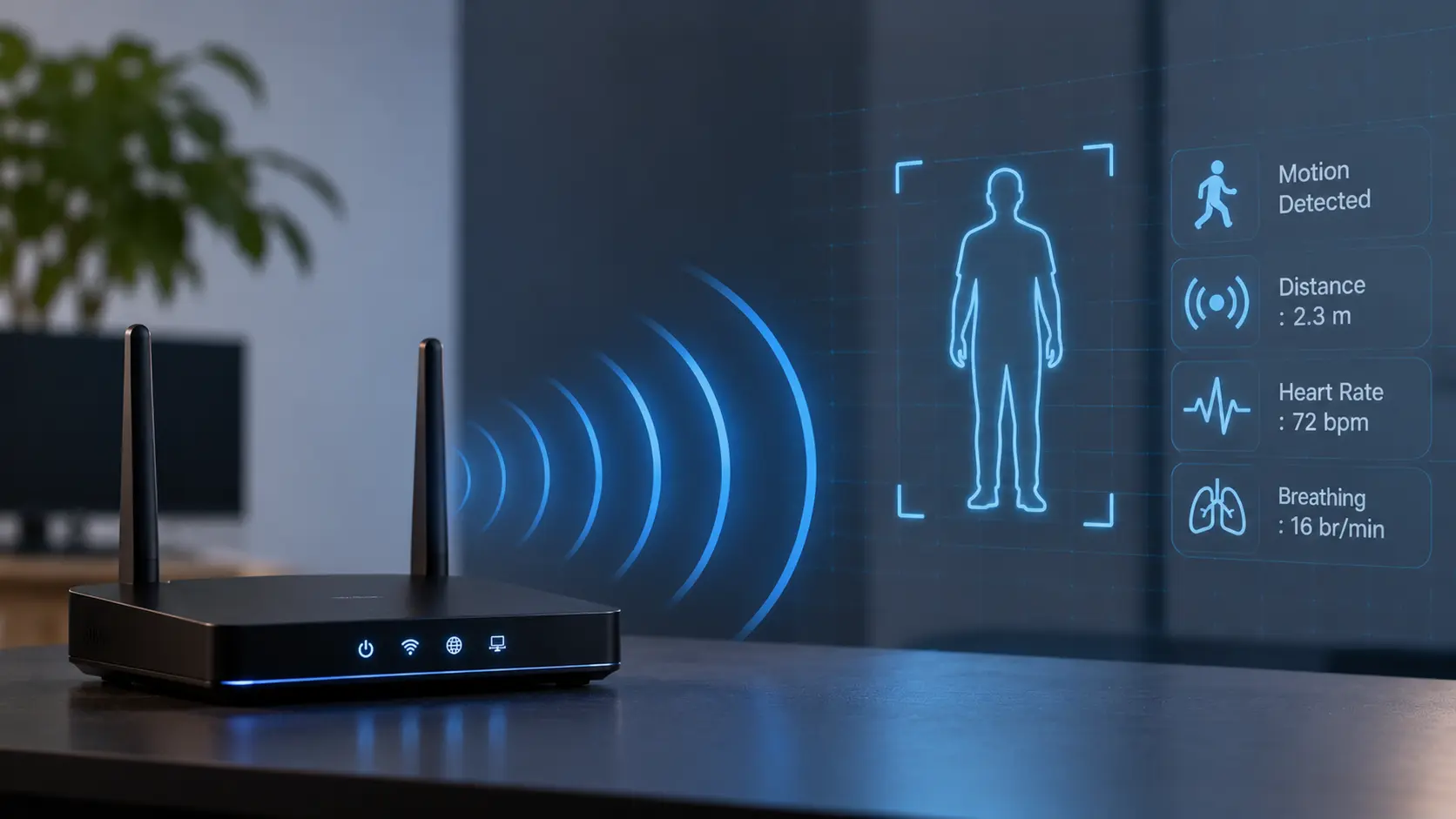
How millimetre-wave radar is enabling machines to detect movement, presence, distance, and even subtle human physiological motion without relying on traditional cameras.
A Different Way of Seeing
When we think about how machines perceive their surroundings, cameras and optical sensors are usually the first technologies that come to mind. From facial recognition systems to autonomous vehicles, cameras have become an essential part of modern sensing technology.
But what if a device could detect a person entering a room, track their movement, recognise a gesture, or even measure their breathing without capturing a single image?
This is where radar-based sensing comes into the picture.
Originally developed for applications such as aircraft detection, navigation, and military surveillance, radar technology has evolved into a compact sensing solution that can be integrated into everyday electronic devices.
In particular, millimetre-wave (mmWave) radar is opening new possibilities in contactless sensing. By transmitting radio-frequency signals and analysing their reflections, these sensors can detect the presence, distance, movement, and position of objects.
More interestingly, advanced radar systems can detect extremely small movements, including the subtle chest displacement associated with human breathing and heartbeat.
As this technology becomes smaller, more affordable, and more accessible, it is finding applications in smart homes, healthcare research, automotive systems, robotics, and industrial automation.
What Is Millimetre-Wave Radar?
Millimetre-wave radar is a sensing technology that operates using electromagnetic waves in the frequency range of approximately 30 GHz to 300 GHz.
The term millimetre-wave comes from the relatively short wavelengths of these signals, which range from approximately 1 to 10 millimetres.
Unlike optical sensors, which rely on reflected visible or infrared light, radar sensors transmit radio-frequency signals and analyse the electromagnetic waves reflected by objects in their surroundings.
A typical radar sensing system consists of:
- Transmitter (TX): Generates and transmits radio-frequency signals into the surrounding environment.
- Receiver (RX): Captures signals reflected from objects.
- Antennas: Transmit and receive electromagnetic waves.
- RF circuitry: Generates, amplifies, and processes high-frequency signals.
- Signal processor: Analyses the received signals to extract information about distance, velocity, and position.
- Embedded controller: Manages sensor configuration, data processing, and communication with the larger system.
Modern mmWave radar sensors often integrate several of these components into a compact semiconductor device, reducing the size and complexity of the overall sensing system.
For example, commercially available 60 GHz radar sensors can support applications ranging from basic motion detection to human presence tracking, gesture recognition, and vital-sign monitoring.
How Does Radar Actually Detect Objects?
The fundamental principle behind radar sensing is relatively simple: transmit a signal, receive its reflection, and analyse the differences between the transmitted and received signals.
When a radar sensor transmits electromagnetic waves, some of that energy reflects from objects in its field of view. The receiver captures these reflections and processes them to estimate different characteristics of the target.
However, modern mmWave radar does much more than simply detect whether an object is present. One widely used technique is Frequency-Modulated Continuous Wave (FMCW) radar.
Understanding FMCW Radar
Unlike conventional pulsed radar, which transmits short bursts of energy, FMCW radar continuously transmits signals whose frequency changes over time. This changing-frequency signal is commonly called a chirp.
The radar receives the reflected signal after it has travelled to the target and back. Because the target is at a certain distance, the received signal is delayed relative to the transmitted signal.
The radar mixes the transmitted and received signals to generate an intermediate-frequency signal, commonly called the beat signal.
By analysing the frequency difference between these signals, the radar can estimate the distance to the target.
“Target distance = (Speed of light × Time delay) / 2”
The division by two accounts for the signal travelling to the object and returning to the radar. In FMCW systems, the time delay is generally inferred from the beat frequency and the known frequency-sweep characteristics.
Detecting Movement Through Doppler Shift
Radar can also determine whether an object is moving and estimate its radial velocity.
When an object moves relative to the radar, the frequency and phase characteristics of the reflected signal change. This phenomenon is associated with the Doppler effect.
By analysing these changes across successive measurements, the system can estimate the object’s movement towards or away from the sensor. This makes radar useful for applications such as vehicle speed measurement, human movement tracking, and motion detection.
Understanding Direction and Position
Determining distance alone is not always sufficient. A radar system may also need to determine where an object is located within its field of view.
This can be achieved using multiple receiving antennas and techniques such as Angle of Arrival (AoA) estimation.
By comparing the phase differences between signals received at different antenna positions, the system can estimate the direction of the reflected signal.
More advanced radar systems use Multiple-Input Multiple-Output (MIMO) antenna configurations to improve spatial resolution and support more detailed object detection and tracking. By combining distance, velocity, and angular information, radar systems can construct a representation of objects within their sensing area.
The Most Interesting Capability: Detecting What We Cannot See
One of the most fascinating applications of mmWave radar is its ability to detect extremely small physical movements.
A person sitting in a chair may appear completely stationary. However, their chest continuously moves as they breathe, and even smaller movements are associated with cardiac activity.
A sufficiently sensitive radar sensor can detect these tiny displacements by analysing changes in the phase of the reflected radio-frequency signal.
Contactless Respiration Monitoring
During breathing, the chest expands and contracts slightly. These movements change the distance between the person and the radar sensor, producing small phase variations in the received signal.
By tracking these variations over time and applying appropriate signal-processing techniques, the system can estimate respiratory patterns and breathing rate. Unlike conventional respiration monitoring methods that require physical contact, radar-based sensing can perform this measurement remotely.
Heartbeat Detection
Radar systems can also detect extremely small movements associated with cardiac activity. However, extracting heartbeat information is more challenging than detecting respiration.
The displacement caused by cardiac activity is typically much smaller than the movement associated with breathing. Radar processing algorithms must therefore separate the relevant signal components from respiration, body movement, environmental noise, and other sources of interference.
Techniques such as filtering, phase analysis, and frequency-domain processing can help extract these physiological signals. These capabilities make radar an interesting technology for contactless physiological monitoring and research.
Importantly, radar-derived heart and respiration measurements are not automatically equivalent to clinical-grade measurements. Their reliability depends on sensor placement, signal quality, algorithms, and validation against appropriate reference instruments.
Radar vs Traditional Sensing Technologies
Radar is not necessarily a replacement for cameras or conventional motion sensors. Instead, it offers a different set of sensing capabilities that can complement existing technologies.
| Feature | Camera | PIR Sensor | mmWave Radar |
|---|---|---|---|
| Detects visual appearance | Yes | No | No |
| Detects movement | Yes | Yes | Yes |
| Measures distance | With suitable depth or vision methods | No | Yes |
| Detects stationary presence | With suitable algorithms | Generally limited | Yes, with suitable processing |
| Detects micro-movements | With specialised processing | Limited | Yes |
| Measures breathing | With specialised vision methods | No | Yes, with suitable algorithms |
| Works in darkness | With suitable cameras | Yes | Yes |
| Captures identifiable images | Yes | No | No |
One of radar’s most significant advantages is that it does not need to capture identifiable visual information to detect movement or presence. This makes it attractive for applications in environments where cameras may be undesirable, such as bedrooms, healthcare facilities, and private indoor spaces.
Radar can also operate in darkness and can often be concealed behind suitable non-metallic enclosure materials. However, radar does not provide the visual detail of a camera. It cannot identify facial features, clothing, or visual objects in the same way. Its performance also depends on the frequency, antenna configuration, target properties, and surrounding environment.
Real-World Applications of Radar-Based Sensing
As radar sensors become increasingly compact and integrated, their applications are expanding beyond conventional automotive and industrial systems.
1. Smart Homes and Intelligent Buildings
Traditional motion-activated lighting systems often use Passive Infrared (PIR) sensors. These sensors are effective at detecting movement, but they can struggle to recognise a person who remains relatively still.
Imagine sitting on a sofa reading a book. A conventional motion detector may eventually assume that the room is empty because there is very little movement. A radar-based presence sensor can detect smaller movements and help determine whether someone is still occupying the room.
This enables smarter lighting, automated air conditioning, occupancy-aware appliances, and intelligent energy management. Radar can also be integrated into devices such as smart speakers, televisions, and home automation systems to support presence-aware interactions.
2. Healthcare and Contactless Monitoring
Healthcare is one of the more promising application areas for radar-based sensing. Contactless respiration monitoring can be useful in situations where continuous physical contact with a person is inconvenient or undesirable.
Potential applications include:
- Monitoring breathing patterns during sleep.
- Contactless respiratory-rate estimation.
- Patient presence and movement monitoring.
- Supporting research into sleep-related conditions.
- Monitoring movement in assisted-living environments.
Because radar does not need to capture conventional images, it may also offer privacy advantages in sensitive environments. However, medical applications require careful validation, and radar-based measurements should not be treated as a replacement for clinically approved monitoring equipment without appropriate evidence and certification.
3. Automotive Safety Systems
Radar has been an important technology in automotive engineering for years. Modern vehicles use radar systems for applications such as adaptive cruise control, collision warning, and blind-spot monitoring.
More recently, interior radar sensing has attracted interest. An in-cabin radar system can detect occupants, monitor movement, and potentially identify the presence of a child or person left inside a vehicle.
Advanced systems can also investigate breathing and other subtle movements, potentially supporting occupant-monitoring applications. These capabilities can contribute to improved vehicle safety, particularly when combined with other sensors and vehicle systems.
4. Robotics and Human-Machine Interaction
Robots operating around humans need to understand their surroundings. Cameras provide rich visual information, but they can be affected by lighting conditions, visual obstructions, and privacy requirements. Radar offers an additional sensing option.
A robot equipped with mmWave radar may use it to detect nearby objects, estimate movement, track human presence, and recognise selected gestures. This can be particularly useful in indoor environments, assistive robotics, and human-machine interaction systems.
Combining radar with cameras, LiDAR, ultrasonic sensors, or inertial sensors can provide a more complete understanding of the environment.
5. Industrial Monitoring and Automation
Industrial environments often contain dust, smoke, vibration, and changing lighting conditions. Radar can provide useful sensing capabilities in situations where conventional optical sensors may face limitations.
Applications include movement detection, object tracking, level measurement, and monitoring the position of equipment or materials. For example, radar sensors can help detect the presence and movement of objects on an automated production line.
Their ability to operate without depending on visible light makes them useful in selected industrial environments.
The Engineering Behind Radar Sensing
Although radar sensing may appear straightforward from the outside, developing a reliable radar-based system requires several engineering disciplines to work together.
RF and Antenna Design
Radar operates at high frequencies, making antenna design and RF signal integrity particularly important. Antenna geometry, placement, gain, field of view, and interference can all influence sensing performance.
At millimetre-wave frequencies, even small variations in the physical layout and surrounding materials can affect RF behaviour.
Digital Signal Processing
The raw data received from a radar sensor is not immediately useful as a direct measurement of human movement or object position. It must be processed to extract meaningful information.
Common signal-processing operations include:
- Fast Fourier Transform (FFT) for frequency analysis.
- Range processing to estimate target distance.
- Doppler processing to estimate radial velocity.
- Angle estimation to determine target direction.
- Filtering to reduce unwanted noise.
- Clustering and tracking to identify and follow moving objects.
These operations transform reflected RF signals into useful representations of the surrounding environment.
Embedded Systems and Firmware
Radar modules often require an embedded processor or integrated digital signal processor to configure the sensor, acquire measurements, and execute processing algorithms.
Firmware also manages communication interfaces, data buffering, timing, and interaction with other system components. Depending on the radar platform, processed data may be transmitted through interfaces such as UART, SPI, or Ethernet to an external computer or application.
Artificial Intelligence and Machine Learning
Traditional radar signal processing can estimate distance, velocity, and direction using mathematical techniques. Machine learning can extend these capabilities by identifying more complex patterns in radar data.
For example, trained models can be used for:
- Human activity recognition.
- Gesture classification.
- Fall detection.
- Occupancy classification.
- Human movement tracking.
- Distinguishing selected types of motion.
The combination of radar and AI makes it possible to move beyond simple motion detection towards more context-aware sensing systems.
Challenges and Limitations
Despite its capabilities, radar-based sensing introduces several engineering challenges:
- Multipath reflections: Radio waves can reflect from walls, floors, furniture, and other objects before reaching the receiver. These additional reflections can create unwanted signals and complicate target detection.
- Interference: Multiple radar devices operating in nearby environments may interfere with one another. Proper configuration and signal-processing techniques are needed to manage this.
- Limited object identification: Radar can estimate the position and movement of objects, but it does not provide the detailed visual information available from cameras.
- Signal-processing complexity: Extracting useful information from raw radar measurements requires specialised algorithms and careful calibration.
- Multiple-target detection: Distinguishing multiple people or objects in the same sensing area can be challenging, particularly when their reflections overlap.
- Environmental effects: Although radar can operate in conditions that affect optical sensors, its performance is not completely independent of the environment. Materials, geometry, reflections, and obstruction can all influence signal propagation.
These limitations mean that selecting the right radar frequency, antenna configuration, processing method, and sensor placement is essential for a successful implementation.
The Future: Towards More Intelligent Contactless Sensing
The future of radar sensing is moving beyond detecting whether something is moving towards understanding what is happening within a physical environment. Advances in semiconductor integration are making radar modules smaller and more accessible. Meanwhile, improvements in digital signal processing and embedded AI are enabling more sophisticated sensing applications on compact hardware.
One particularly interesting direction is the combination of radar with other sensing technologies. For example, a smart building could combine radar-based presence detection with temperature, humidity, and air-quality sensors to create a more context-aware environment. A wearable or healthcare monitoring system could combine radar measurements with conventional physiological sensors to provide additional information about a person’s activity and breathing patterns. In robotics, radar could complement cameras and LiDAR to improve environmental awareness under changing lighting conditions.
Another promising area is privacy-conscious sensing. As more devices become capable of monitoring human activity, radar offers an alternative approach where useful information can be extracted without necessarily collecting identifiable visual data. The broader opportunity is to develop systems that can understand physical environments without depending entirely on cameras or conventional optical sensing.
Conclusion: A New Perspective on Machine Perception
Radar-based sensing represents an important evolution in how electronic systems perceive the physical world. By transmitting and analysing reflected electromagnetic signals, mmWave radar can detect distance, velocity, direction, presence, and even extremely small movements associated with human physiology.
Its ability to operate without capturing conventional images makes it particularly interesting for applications where privacy, low-light operation, and contactless sensing are important. From intelligent buildings and automotive safety systems to healthcare research and robotics, radar is expanding the possibilities of embedded sensing.
“The future of machine perception may not depend on how clearly a device can see an object, but on how intelligently it can interpret the signals coming from its surroundings.”
