
Digital Twins: Creating Virtual Copies of the Physical World
Blog by Nihal Noushad K
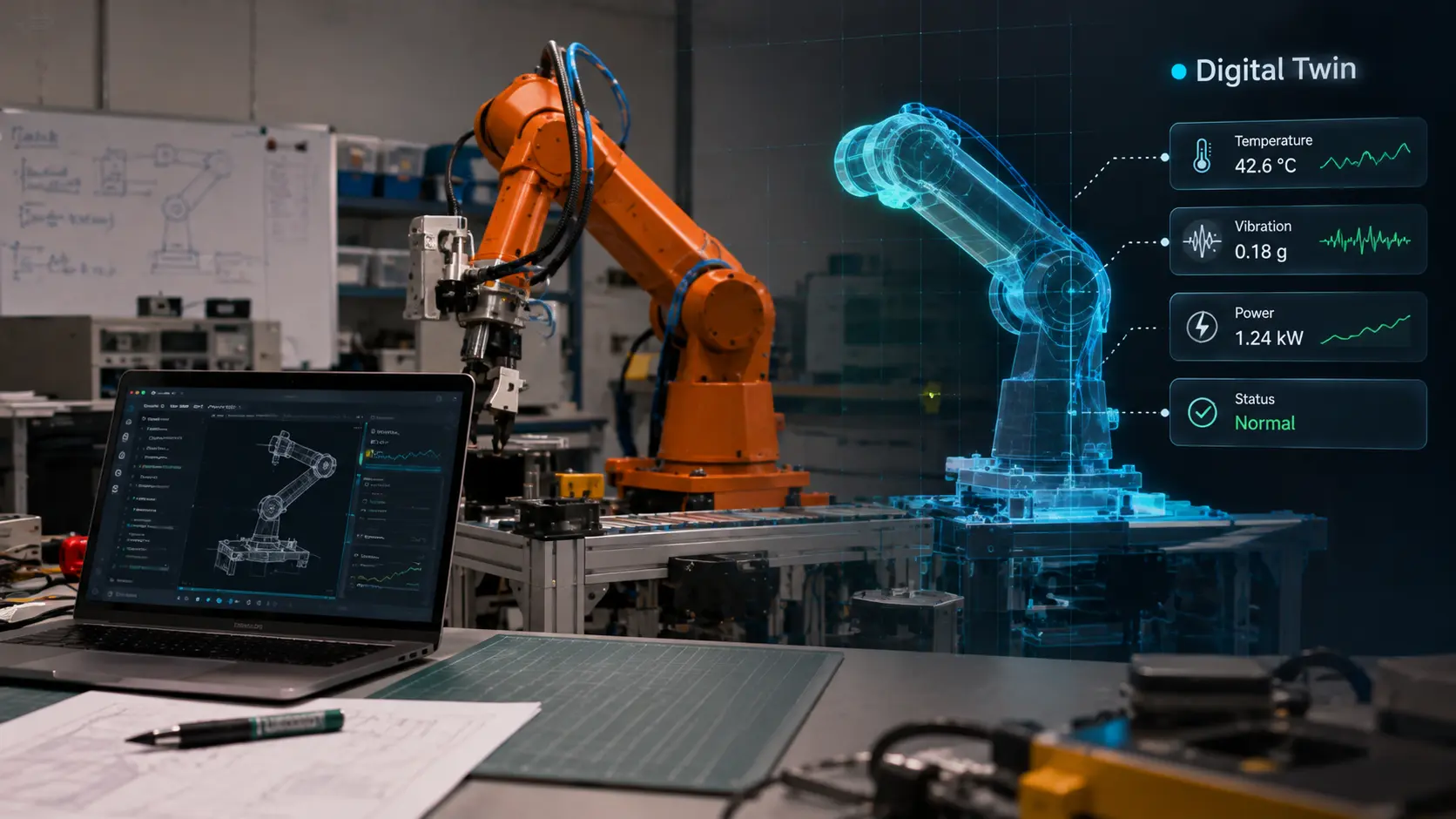
How IoT, artificial intelligence, and real-time data are connecting the physical and digital worlds.
When the Physical World Gets a Digital Identity
Imagine being able to monitor a machine’s internal condition, observe how it behaves under different operating conditions, and predict potential failures without physically interacting with it.
What if engineers could test changes to an industrial production line, evaluate the performance of an aircraft engine, or monitor an entire building through a digital environment that continuously reflects what is happening in the real world?
This is the idea behind Digital Twins.
A digital twin is more than a 3D model or a virtual representation of a physical object. It is a dynamic digital counterpart that uses data from its physical equivalent to reflect its condition, behaviour, and performance over time.
By combining sensors, Internet of Things (IoT) connectivity, artificial intelligence, simulation, and data analytics, digital twins are changing how engineers design, monitor, operate, and maintain complex systems.
From manufacturing facilities and smart cities to healthcare and aerospace engineering, digital twins are becoming an important part of the next generation of intelligent infrastructure.
What Exactly Is a Digital Twin?
A digital twin is a digital representation of a physical object, process, or system that is connected to its real-world counterpart through data.
Unlike a conventional computer model, which may represent how something is expected to behave, a digital twin can continuously receive information from the physical system and update its digital state accordingly.
For example, consider an industrial electric motor.
A conventional 3D model may show the motor’s dimensions, internal components, and mechanical structure. A digital twin goes further by receiving live information about the motor’s operating temperature, rotational speed, vibration, electrical current, and other parameters.
This data allows the digital representation to reflect the motor’s current operating condition. Engineers can then use the digital twin to analyse performance, identify unusual behaviour, simulate different operating conditions, and investigate potential problems.
A digital twin can represent different levels of complexity:
- Component twins: Represent individual components such as sensors, motors, bearings, or electronic circuits.
- Asset twins: Represent complete physical assets such as industrial machines, vehicles, or aircraft.
- System twins: Represent interconnected systems, such as production lines or building infrastructure.
- Process twins: Represent operational processes such as manufacturing workflows, logistics, or energy distribution.
The complexity of a digital twin depends on the application, the available data, and the level of detail required.
How Does a Digital Twin Work?
A digital twin typically operates through a continuous exchange of information between a physical system and its digital representation.
Several technologies work together to make this possible:
1. The Physical Asset
Everything begins with a real-world object or system. It could be an industrial machine, an aircraft engine, a vehicle, a wearable device, or an entire manufacturing facility. The physical asset produces measurable information about its operating condition and behaviour.
2. Sensors and Data Acquisition
Sensors collect information from the physical system. Depending on the application, these may include:
- Temperature sensors for monitoring thermal conditions.
- Accelerometers and gyroscopes for detecting movement and vibration.
- Pressure sensors for monitoring fluid and gas systems.
- Current and voltage sensors for monitoring electrical performance.
- Position sensors for tracking mechanical movement.
- Optical sensors and cameras for visual monitoring.
These sensors convert physical phenomena into measurable electrical signals. The acquired data is processed by embedded controllers, data acquisition systems, or connected devices before being transmitted to the digital environment.
3. Connectivity and Data Transmission
The collected information must reach the digital twin. Communication technologies such as Wi-Fi, Ethernet, Bluetooth Low Energy, cellular networks, and industrial communication protocols can be used depending on the system’s requirements. IoT gateways and edge devices may also process, filter, or aggregate sensor data before sending it to a central platform. For systems requiring rapid responses, some processing takes place locally rather than depending entirely on cloud infrastructure.
4. The Digital Model
The digital representation is where physical information becomes useful. It may contain:
- A 3D representation of the physical asset.
- Mathematical models describing its behaviour.
- Information about components and their relationships.
- Historical operating data.
- Real-time sensor measurements.
- Performance and operational parameters.
The digital model is updated using incoming information from the physical system. This allows engineers to observe the state of the asset through a digital interface and investigate how it behaves under different conditions.
5. Analytics, Simulation, and Artificial Intelligence
Once the digital twin receives data, analytical tools can help extract meaningful information. Artificial intelligence and machine-learning models can identify patterns, detect anomalies, estimate remaining useful life, and predict potential failures. Simulation tools can also evaluate how the system may behave when operating conditions or design parameters change.
For example, an engineer could investigate how increasing the operating temperature affects a motor’s performance or how changing a production schedule influences manufacturing efficiency. The results can support better engineering decisions and, in some implementations, help optimise the physical system.
Digital Twin vs Traditional Simulation: What’s the Difference?
Digital twins and simulations are closely related, but they are not the same thing. A traditional simulation uses mathematical or computational models to predict how a system behaves under specified conditions. A digital twin can incorporate these simulations while also maintaining a connection with an actual physical asset through operational data.
Consider a manufacturing machine. A simulation might predict its performance using predefined parameters. A digital twin can receive updated measurements from the real machine and use those measurements to maintain a representation of its current operating state.
| Feature | Traditional Simulation | Digital Twin |
|---|---|---|
| Primary purpose | Study predicted behaviour | Represent and analyse a physical system |
| Data source | Defined inputs and assumptions | Physical data, historical data, and models |
| Connection to physical asset | Not necessarily connected | Connected through data integration |
| Updates | When the simulation is modified or rerun | Can update continuously or periodically |
| Predictive analysis | Yes | Yes |
| Real-time monitoring | Not inherently | A common capability |
Not every digital twin operates in real time, and not every digital twin includes a sophisticated 3D visualisation. The defining feature is its meaningful relationship with a physical counterpart through data, rather than simply how realistic its graphics appear.
Real-World Applications of Digital Twins
Digital twins are already being used across several industries to improve monitoring, planning, and operational efficiency.
1. Manufacturing and Industrial Automation
Manufacturing is one of the most established application areas for digital twin technology. A digital twin of a production line can represent individual machines, conveyor systems, robotic arms, and manufacturing processes. By integrating sensor data with operational models, engineers can monitor production performance, identify bottlenecks, and investigate unexpected machine behaviour. For example, vibration and temperature measurements from an industrial motor can help identify unusual operating conditions before they develop into major equipment failures. Digital twins can also be used to evaluate production-line modifications before implementing them in the physical factory.
2. Aerospace and Automotive Engineering
Aircraft engines, automotive powertrains, and other complex mechanical systems generate large amounts of operational data. Digital twins can combine this information with engineering models to support performance monitoring, maintenance planning, and lifecycle analysis. In aerospace engineering, digital representations can help engineers investigate how components behave under different operating conditions. In automotive development, digital twins can support vehicle design, manufacturing optimisation, and the analysis of connected vehicle systems.
3. Healthcare and Medical Technology
Digital twin concepts are also finding applications in healthcare. At the equipment level, digital twins can represent medical devices, hospital infrastructure, and healthcare facilities. At the physiological level, researchers are exploring digital representations of organs and biological systems to investigate how they respond to different conditions. Such approaches may eventually support more personalised analysis and treatment planning. However, creating reliable patient-specific digital twins is technically challenging. Biological systems are complex, and medical applications require careful validation, appropriate clinical evidence, and strong privacy protections.
4. Smart Cities and Infrastructure
Cities contain interconnected systems involving transportation, electricity, water distribution, buildings, and communication networks. Digital twins can combine information from these systems to provide a broader view of urban infrastructure. For example, a digital twin of a city may incorporate traffic information, environmental measurements, energy consumption, and building data. Urban planners can use these representations to evaluate infrastructure changes, study traffic patterns, and investigate the potential effects of development projects.
5. Energy and Power Systems
Power plants, renewable energy installations, and electrical distribution networks can benefit from digital twin technology. A digital twin of a wind turbine, for example, may combine wind speed, rotational speed, vibration, temperature, and electrical output measurements. These measurements can be analysed to understand operating efficiency and identify abnormal behaviour. Similar approaches can support monitoring and optimisation in solar installations, industrial power systems, and electrical grids.
The Role of Artificial Intelligence in Digital Twins
Artificial intelligence makes digital twins more capable by allowing them to interpret large volumes of operational data and identify patterns that may not be obvious through conventional monitoring. Without advanced analytics, a digital twin may primarily function as a monitoring and visualisation system. With machine learning, it can begin identifying relationships between different operating parameters and estimating how a physical system may behave in the future.
Some important applications include:
- Predictive maintenance: Machine-learning models analyse historical and real-time sensor measurements to identify patterns associated with equipment degradation or failure.
- Anomaly detection: AI systems recognise deviations from normal operating behaviour and flag unusual conditions for further investigation.
- Performance optimisation: AI can analyse operating parameters and recommend changes that may improve efficiency, reduce energy consumption, or increase productivity.
- Simulation assistance: Machine-learning models can act as faster approximations of computationally expensive simulations in suitable applications.
- Automated decision support: Advanced systems can combine digital twin data with optimisation algorithms to recommend or initiate operational adjustments.
The combination of AI and digital twins creates an opportunity to move from simply observing physical systems towards understanding, predicting, and improving their behaviour. However, predictions are only as reliable as the data, models, and assumptions behind them.
The Engineering Behind a Digital Twin
Building a useful digital twin requires much more than creating a visual model. It involves integrating multiple engineering disciplines:
- Embedded systems and electronics: Microcontrollers, sensors, data acquisition circuits, and communication modules provide the connection between the physical asset and its digital counterpart.
- IoT infrastructure: Connectivity technologies and gateways allow operational information to move between devices, local systems, and cloud platforms.
- Mechanical and electrical modelling: CAD tools, mathematical models, and simulation software represent the physical structure and behaviour of the asset.
- Software engineering: Backend services, databases, APIs, and visualisation platforms manage the information and provide interfaces for engineers.
- Data science and AI: Analytical models process sensor measurements, identify patterns, and generate predictions.
These components must work together reliably. For instance, inaccurate sensor readings can result in an incorrect representation of the physical system. Poor communication can introduce delays or missing information, while an outdated model may fail to reflect changes in the actual asset. The accuracy and usefulness of a digital twin therefore depend on the quality of the entire engineering system, not just the sophistication of its software.
Challenges and Limitations
Despite its potential, digital twin technology introduces several technical and operational challenges:
- Data Quality and Sensor Accuracy: A digital twin depends on accurate information from the physical system. Faulty sensors, electrical noise, calibration errors, and missing measurements can affect the reliability of its digital representation.
- Integration With Existing Systems: Industrial environments often contain equipment from different manufacturers, using different communication protocols, data formats, and software platforms. Connecting these systems into one consistent digital environment can be complicated.
- Computational Requirements: High-fidelity simulations and complex digital models can require significant processing resources. Large-scale implementations may need specialised computing infrastructure, distributed processing, or cloud-based platforms.
- Cybersecurity and Data Privacy: Digital twins may contain sensitive operational information about industrial facilities, infrastructure, and connected devices. Unauthorised access or manipulation of this information could have serious consequences, particularly when digital twins are connected to operational control systems. Strong authentication, encryption, access controls, and secure device communication are therefore essential.
- Cost and Implementation Complexity: Developing a digital twin requires investment in sensors, connectivity, software platforms, engineering models, and ongoing maintenance. Not every application needs a sophisticated digital twin. The complexity of the implementation should match the actual operational requirements and expected benefits.
The Future: Towards More Intelligent and Autonomous Systems
As IoT infrastructure, AI capabilities, and simulation technologies continue to advance, digital twins are expected to become more interconnected and sophisticated. One promising direction is the development of system-level digital twins that represent entire industrial facilities rather than individual machines.
Another is the integration of digital twins with autonomous systems and robotics. Imagine a robotic manufacturing cell with a digital counterpart that continuously receives information about robot positions, motor temperatures, production status, and sensor measurements. The digital environment could be used to evaluate alternative robot movements, identify potential collisions, optimise production sequences, and support maintenance planning.
Advances in edge computing may also allow parts of digital twin processing to happen closer to the physical equipment, reducing communication delays and dependence on centralised infrastructure. Generative AI could further simplify how engineers interact with these systems by allowing them to query operational information using natural language and receive explanations of complex system behaviour.
Ultimately, the combination of digital twins, AI, and connected hardware could create systems that are not only capable of monitoring their physical counterparts but also helping engineers optimise how they operate.
Conclusion: Bridging the Physical and Digital Worlds
Digital twins represent an important evolution in the relationship between physical engineering and digital technology. By combining sensor networks, IoT connectivity, simulation, and artificial intelligence, they provide a way to create digital representations that reflect the behaviour and condition of real-world systems.
Their value goes beyond visualisation. They allow engineers to analyse operational data, investigate potential failures, evaluate design changes, and make more informed decisions throughout a product’s lifecycle.
“The next generation of engineering may not just involve designing physical systems. It will involve creating intelligent digital counterparts that help us understand, predict, and improve the real world.”
From industrial machines and aircraft engines to smart cities and healthcare infrastructure, digital twins are opening new possibilities for understanding and managing increasingly complex systems. As connected devices become more capable and AI becomes increasingly integrated into engineering workflows, the boundary between physical and digital environments will continue to become less distinct.
