
Edge AI: Bringing Intelligence Closer to the Hardware
Blog by Nihal
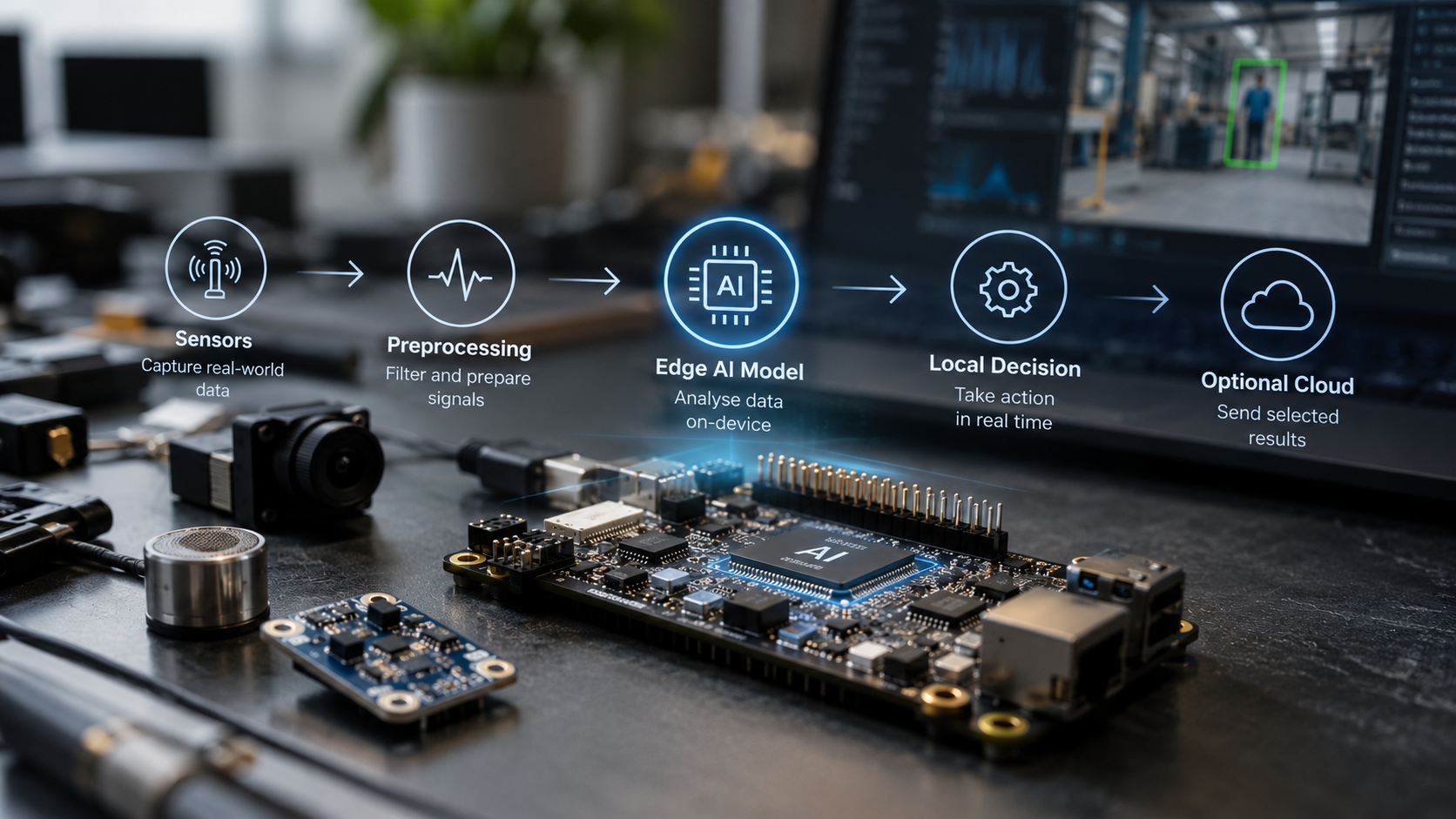
How edge computing, embedded processors, and on-device machine learning are transforming the next generation of intelligent devices.
The Shift Towards Intelligent Devices
Artificial intelligence is no longer confined to large data centres or cloud-based applications. It is increasingly finding its way into the physical devices that we interact each and every day, from fitness trackers and smart cameras to industrial sensors, autonomous systems, robots, and other kinds of “smart and intelligent” devices
Traditionally, Most of the AI applications have been relying on sending data to remote servers for processing and returning the results to the device. While this approach enables access to powerful computing resources, it can introduce network latency, increase data transmission requirements, and create dependencies on internet connectivity.
Edge AI is changing this approach by bringing machine learning capabilities closer to the source of the data. Instead of relying entirely on the cloud, devices can process sensor readings, recognise patterns, and make decisions locally by its own hardware.
This shift represents an important development in embedded systems engineering. By combining efficient hardware with optimised AI models, engineers can build devices that are not only connected but also capable of interpreting their surroundings and responding intelligently in real time.
What Is Edge Computing, and How Does Edge AI Fit In?
Edge computing is a computing architecture in which data is processed near the point where it is generated, rather than being sent entirely to a cloud server off site.
Edge AI takes this concept further by enabling artificial intelligence and machine learning models to run on devices at the edge of a network. These devices may include microcontrollers, embedded processors, smartphones, industrial gateways, and specialised hardware for AI.
Although the terms are closely related, they are not interchangeable. Edge computing can involve conventional data processing without AI, while Edge AI specifically involves running AI inference locally.
Consider a vibration sensor attached to an industrial motor. A conventional monitoring system might transmit vibration measurements to a server for analysis. An edge-enabled system could analyse the measurements locally, while an Edge AI system could use a trained machine learning model to recognise unusual vibration patterns associated with potential mechanical faults.
The result is a system that can identify relevant events closer to where they occur, potentially reducing response times and unnecessary data transmission.
The Hardware Behind Edge AI
Running AI on a compact device is not simply a matter of installing a machine learning model. It requires careful coordination between processing hardware, memory, power management, sensors, and embedded software.
1. Microcontrollers and Embedded Processors
Microcontrollers (MCUs) are widely used in embedded systems because they combine processing, memory, and peripheral interfaces in a compact, energy-efficient package. They are suitable for applications that involve sensor readings, control systems, and relatively lightweight machine learning models.
More computationally demanding applications may use microprocessors (MPUs), application processors, or system-on-chip (SoC) platforms that provide greater processing capability and memory support.
The choice depends heavily on the task. A simple gesture-recognition model may run on a low-power microcontroller, while real-time object detection from a camera may require a more capable processor or dedicated accelerator.
2. Neural Processing Units and Hardware Acceleration
As AI workloads become more demanding, specialised hardware can help execute neural network operations more efficiently.
A Neural Processing Unit (NPU) is designed to accelerate operations commonly used in neural networks. Rather than requiring a general-purpose CPU to perform every computation, an NPU can handle supported AI operations while the CPU manages application logic, sensor communication, and other tasks.
For example, Arm’s Ethos-U family of NPUs is designed for efficient machine learning inference in embedded and edge devices. Such hardware can enable more demanding AI applications within constrained power and silicon budgets.
However, an accelerator is not automatically necessary for every Edge AI application. Small models may run adequately on a CPU or microcontroller, depending on their computational requirements and performance targets.
3. Sensors, Memory, and Power Management
The quality of an Edge AI system also depends on the hardware surrounding its processor.
Sensors such as accelerometers, gyroscopes, microphones, cameras, and optical heart-rate sensors provide the input data used by AI models. Memory stores model parameters, intermediate calculations, and application data. Power-management circuits regulate energy consumption and help devices operate within their battery or power-supply limits.
In battery-powered devices, these elements must be designed together. A larger model may improve prediction quality but require more memory and processing time. A higher-performance processor may reduce inference time but increase peak power consumption.
Successful Edge AI design therefore requires a system-level approach rather than selecting components based on processing speed alone.
How Edge AI Works: From Sensor Data to Decisions
A typical Edge AI application follows a sequence of operations:
- Data acquisition: Sensors collect information such as movement, temperature, sound, or images.
- Preprocessing: The device filters noise, normalises measurements, or extracts useful signal features.
- Model inference: A trained machine learning model analyses the processed data and produces a prediction or classification.
- Decision-making: Embedded application logic interprets the model output and determines the appropriate response.
- Communication, when needed: The device transmits selected results, alerts, or summaries to another system.
Consider a wearable device monitoring movement. Its accelerometer continuously measures motion, and an Edge AI model analyses patterns in those measurements to classify activities like walking, running or remaining stationary.
Instead of transmitting every raw measurement for remote classification, the device can perform inference locally and send only selected results to the companion application.
This does not eliminate the need for connectivity. Rather, it allows the device to make useful decisions independently while using the cloud for functions that benefit from additional computing resources, long-term storage, or analysis across multiple devices.
Why Edge AI Matters
Lower Latency and Faster Responses
Local inference removes the need to send every input to a remote server and wait for a response. This can be particularly valuable in robotics, industrial automation, and interactive devices, where timely decisions matter.
The actual improvement depends on the model, processor, network conditions, and application architecture.
Reduced Data Transmission
Processing information locally can reduce the amount of raw sensor data transmitted over a network. For devices that generate continuous streams of audio, video, or motion measurements, this can reduce bandwidth requirements and communication overhead.
Improved Privacy Opportunities
Keeping sensitive data on a device or within a local network can reduce the amount of information sent to external services. For instance, a smart camera could classify activity locally and transmit an event notification instead of continuously uploading video.
However, local processing alone does not guarantee privacy or security. Secure storage, access controls, encryption, software updates, and careful data-handling practices remain essential.
Greater Resilience to Connectivity Loss
A device that performs inference locally can continue carrying out supported functions when its internet connection is unavailable. This is useful in remote monitoring, industrial environments, and mobile devices.
Cloud-based features, remote dashboards, and synchronisation may still become unavailable, but the core local processing can continue if the system has been designed for offline operation.
Where Edge AI Is Making an Impact
Smart Wearables and Personal Devices
Fitness trackers and smartwatches combine sensors, embedded processors, and software to interpret physiological and movement-related signals.
Edge AI can support activity classification, gesture recognition, sleep-related pattern analysis, and other personalised features. Processing selected signals locally may also reduce unnecessary data transmission and help devices operate efficiently within limited battery capacity.
For health-related applications, the accuracy and limitations of each model must be carefully validated. A model-generated estimate should not automatically be treated as a medical diagnosis.
Industrial IoT and Predictive Maintenance
Industrial machines often produce continuous streams of vibration, temperature, acoustic, and electrical measurements. Edge AI can analyse these signals to identify unusual operating patterns and flag potential maintenance requirements.
Local analysis can help operators respond sooner and reduce the need to transmit every measurement to a central server. The effectiveness of such systems depends on representative training data, reliable sensors, and validation under actual operating conditions.
Robotics and Autonomous Systems
Robots must interpret sensor inputs and respond to changing environments. Edge AI can support object recognition, visual inspection, gesture interpretation, and perception tasks that benefit from local processing.
In these applications, inference speed is only one consideration. Engineers must also account for deterministic control requirements, sensor timing, system reliability, and the consequences of incorrect predictions.
Smart Cameras and Connected Devices
Smart cameras, environmental monitoring systems, and other connected devices can use Edge AI to identify relevant events near the point of data collection.
For example, a camera could detect whether a person has entered a restricted area and send an alert when necessary. This can reduce unnecessary video transmission while allowing the device to respond to specific events.
The Engineering Challenges: Intelligence Within Constraints
Despite its advantages, Edge AI introduces several engineering challenges.
- Memory limitations: Embedded devices may have limited RAM and flash storage. The model, intermediate tensors, firmware, and application must fit within the available memory budget.
- Power consumption: Continuous sensing and inference can shorten battery life. Engineers must optimise sampling rates, model execution, processor sleep states, and communication schedules.
- Model size and accuracy: Smaller models are often easier to deploy, but aggressive compression can affect prediction quality. The appropriate trade-off must be established through testing.
- Thermal and computational limits: More demanding workloads can increase power draw and heat generation. Compact enclosures may make thermal management particularly challenging.
- Real-world reliability: Sensor noise, changing environments, differences between users, and unexpected operating conditions can affect model performance. A model that performs well in a training dataset may not perform equally well in the field.
Techniques such as quantisation, pruning, efficient model architectures, and hardware-aware optimisation can help address some of these constraints. Nevertheless, the final system must be evaluated on its intended hardware and under realistic operating conditions.
Edge AI and Cloud AI: A Complementary Future
Edge AI does not mean that cloud computing is becoming unnecessary. The two approaches serve different purposes and can work together.
Edge devices are well suited to time-sensitive inference, local control, and processing that benefits from keeping data close to its source. Cloud platforms provide resources for computationally intensive workloads, centralised data storage, large-scale analytics, and model training.
A hybrid architecture can combine the strengths of both. An embedded device may identify events locally, transmit selected information to the cloud, and receive updated models or configuration settings when connectivity is available.
This division of responsibilities allows engineers to choose where each operation should take place based on latency, privacy, bandwidth, reliability, and computational requirements.
Building Intelligence Into the Device
Edge AI represents an important evolution in the way intelligent hardware is designed. By combining sensors, efficient processors, specialised accelerators, and optimised machine learning models, engineers can create devices that interpret data and respond locally rather than depending entirely on remote computing infrastructure.
The challenge is not simply to make AI models smaller. It is to develop complete systems in which hardware, software, power consumption, memory, and model performance work together reliably.
As embedded computing continues to advance, Edge AI is opening new possibilities for wearables, industrial monitoring, robotics, and connected devices. For hardware engineers, this creates an opportunity to move beyond building systems that merely collect and transmit data towards developing devices that can interpret information and act on it intelligently.
The future of intelligent hardware will not be defined by processing power alone, but by how effectively intelligence can be delivered within the practical constraints of real-world devices.
