
Wearable AI: How Smart Wearables Are Becoming Miniature Health-Computing Platforms
Blog by Nihal Noushad K
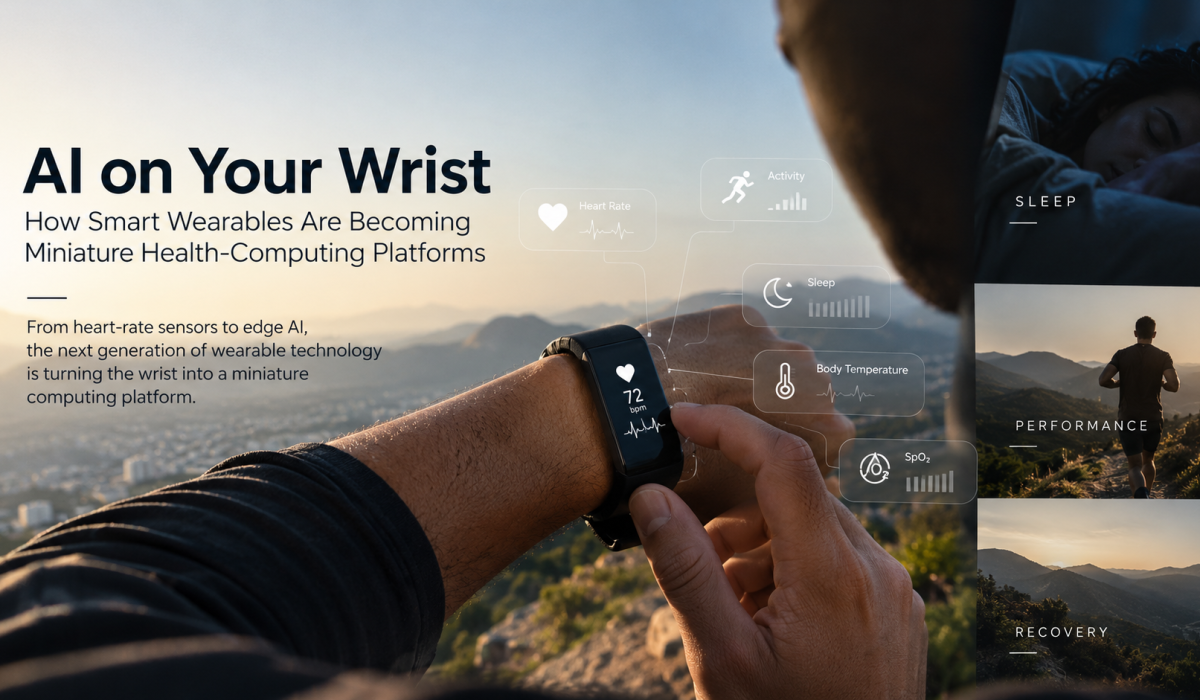
From heart-rate sensors to edge AI, the next generation of wearable technology is turning the wrist into a miniature computing platform.
What if the device on your wrist knew more about your body than the number of steps you took today?
Modern smartwatches and fitness trackers are already doing far more than counting steps. They continuously monitor movement, heart rate, sleep, temperature and other physiological signals – and increasingly use artificial intelligence to turn this raw sensor data into meaningful insights.
Devices from companies such as WHOOP, Fitbit and Apple represent a broader shift in wearable technology: from devices that simply measure the body to systems that can interpret it.
Behind this transformation is a powerful combination of advanced sensors, embedded systems, signal processing, machine learning and low-power computing.
What Is Wearable AI?
Wearable AI refers to the use of artificial intelligence and machine-learning techniques in devices worn on the body to analyse data collected from sensors.
A modern wearable can contain several types of sensors, including:
- PPG sensors for optical heart-rate measurements
- Accelerometers and gyroscopes for movement tracking
- Temperature sensors for monitoring changes in skin temperature
- ECG sensors for measuring electrical activity of the heart
- Optical sensors for applications such as blood-oxygen estimation
- Barometers and GPS for environmental and activity information
Individually, these sensors provide relatively simple measurements.
The real intelligence comes from combining them.
A simplified wearable-AI pipeline looks like this:
Human body → Sensors → Signal processing → Sensor fusion → AI/ML → Health insights
This transformation from raw signals into meaningful information is where modern wearable technology is becoming increasingly sophisticated.
How PPG Sensors Measure Your Heart
One of the most important technologies in wearable health tracking is photoplethysmography (PPG).
PPG sensors use LEDs to shine light into the skin and photodetectors to measure changes in the reflected or transmitted light.
As blood volume changes with each heartbeat, the optical signal changes as well.
Algorithms can analyse these changes to estimate heart rate and other physiological characteristics.
But there is a catch.
Your wrist is constantly moving.
During exercise, the PPG sensor is dealing with movement, vibration, changes in skin contact, sweat and environmental interference – all while trying to identify a relatively small physiological signal.
This is where the rest of the wearable’s hardware becomes important.
Why Sensor Fusion Matters in Wearable Technology
A wearable doesn’t have to rely on a single sensor.
An accelerometer can measure movement while a PPG sensor measures optical changes. A gyroscope can provide information about orientation and motion. Temperature sensors can provide additional context.
By combining these signals, algorithms can better understand what is happening.
This approach is known as sensor fusion.
It is one of the fundamental technologies behind intelligent wearables because the human body is an extremely noisy environment for sensors.
The challenge isn’t simply collecting more data.
It is determining which parts of that data are useful.
The Biggest Challenge: AI on a Tiny Battery
Building an AI system for a data centre is fundamentally different from building one for a wearable.
A data centre can use thousands of powerful processors.
A wearable has to operate from a battery that may be only a few hundred milliamp-hours while remaining small, lightweight and comfortable.
At the same time, it may need to continuously:
- Sample sensors
- Process signals
- Run algorithms
- Perform machine-learning inference
- Store data
- Communicate wirelessly
- Manage the display and other components
This creates one of the biggest challenges in wearable hardware design:
How much intelligence can we deliver per milliwatt?
This is why wearable AI isn’t necessarily about using the most powerful processor available.
It is about designing the most energy-efficient computing architecture for the task.
WHOOP, Fitbit and Apple Watch: Different Approaches to Wearable Intelligence
The evolution of products such as WHOOP, Fitbit and Apple Watch demonstrates how different companies are approaching the same fundamental engineering problem.
WHOOP: Continuous Physiological Monitoring
WHOOP has built its platform around continuous monitoring of physiological signals and translating them into metrics related to sleep, recovery and training.
Its screenless design (which means you have to wear another watch to know the time–TWO WATCHES) also highlights an important aspect of wearable engineering: the device doesn’t necessarily need to constantly display information to be useful.
The sensing and computing can happen in the background while the user interacts with the data through another device.
Fitbit: From Fitness Tracker to Health Platform
Fitbit helped popularise wearable activity tracking and has progressively expanded into areas such as sleep, heart health and broader wellness monitoring.
Its evolution illustrates how increasing sensor capabilities and machine-learning algorithms can transform a simple activity tracker into a more comprehensive health and wellness platform.
Apple Watch: A Wearable Computer
Apple Watch takes a broader approach, combining health sensing with the capabilities of a general-purpose smartwatch.
It integrates technologies such as optical heart sensing, ECG, motion sensing and temperature measurement alongside wireless connectivity, applications and conventional smartwatch functions.
These devices differ significantly in design and functionality, but they all demonstrate the same underlying trend:
The wearable is becoming a computing platform rather than simply a collection of sensors.
Personalised AI Could Be the Next Step
One of the most interesting possibilities for wearable AI is personalisation. Human physiology varies significantly from person to person.
A particular heart rate, sleep pattern or temperature variation may be perfectly normal for one individual but unusual for another.
With enough longitudinal data, machine-learning systems can potentially establish an individual’s baseline and identify changes relative to it.
This creates a future where wearable AI becomes increasingly personalised:
Generic model → Personal baseline → Continuous adaptation → Personalised insights
However, it is important to distinguish between wellness-oriented insights and clinically validated medical measurements. An algorithm identifying a pattern does not automatically mean that a wearable can diagnose a medical condition.
From Smart Devices to Intelligent Companions
The evolution of wearables can be viewed as a progression:
Step counter → Fitness tracker → Smartwatch → Health-monitoring device → Intelligent wearable
The next generation may go even further.
Instead of simply collecting data and presenting it to the user, wearables could become continuously operating, personalised edge-computing systems that understand context and identify meaningful changes.
The most exciting part isn’t that your watch can measure your heart rate.
It is that a device small enough to fit around your wrist can continuously sense, compute, learn and adapt.
And that makes wearable technology one of the most interesting intersections of AI, electronics and embedded systems today.
The future of AI may not always look like a computer sitting on a desk or a GPU running inside a data centre.
Sometimes, it may look like a small device quietly sitting on your wrist.
The next big step in wearable technology isn’t simply making devices smarter. It’s making the hardware itself intelligent.
